
One word – “house” – conjures up several ideas.
A house is a home. It’s a place of comfort and serenity, a haven where one can go to hang one’s hat, to get a good night’s sleep, and to exist in peace in the bounty of family.
But …
In twists of fate, houses can be destroyed both from outside forces and from within. If not properly maintained, they can turn into little more than dens of escape from the true troubles of one’s life. What you bring into a home can ultimately affect not only yourself but everyone else under the same roof … and what even risk do housemates share when they don’t truly know one another?
Family dramas aren’t always worth the effort, both to consider as well as to watch for pure enjoyment. I tend to find them all a bit overly dramatic, but when they’re handled with greater deftness – and avoid the usual crying, hand wringing, and big shouting matches – they can be quite remarkable. It’s this definition of family – and how it interacts with a wider society at large – that makes Strangers In The House a worthwhile film.
Well, that and the fact that it’s a fabulous courtroom drama, as well …
(NOTE: The following review will contain minor spoilers necessary solely for the discussion of plot and/or characters. If you’re the type of reader who prefers a review entirely spoiler-free, then I’d encourage you to skip down to the last few paragraphs for the final assessment. If, however, you’re accepting of a few modest hints at ‘things to come,’ then read on …)
From the film’s IMDB.com page citation:
“Loursat, a lawyer, lives with his daughter Nicole. Abandoned by his wife about 20 years ago, he has sunk into alcoholism. One day, the corpse of a stranger is discovered in the attic of his residence.”
Ahhh, God bless the stewards over IMDB.com! From time-to-time, their provided synopses are so incomplete that they produce a chuckle, and that’s the case this morning. While the above does highlight only a vague hint as to the picture’s actual story, I suppose that might be enough to go on for some folks searching for a title to explore, but the brevity certainly leaves a great deal more context to be desired.
Strangers In The House is a deft character study of both one man – celebrated actor Raimu whom IMDB.com states Orson Welles called the greatests actor who ever lived plays the somewhat fallen pariah Maitre Hector Loursat – and the society of its time. Somewhere – I couldn’t say where at the moment – I’d read that the film was called a great example of film noir, and I’ll just say in my humble opinion I think that’s a bit off-base: for starters, Strangers isn’t an American release (it’s a French film), and it only flirts with the tenets of noir the way so many features from the early 1940’s and well into the 1950’s did. I can understand the association; still, I think it’s inaccurate.
Based on the novel by Georges Simenon, the Henri Decoin film peels back the layers that time and experience have left on Loursat. Abandoned by what we’re led to believe was a promiscuous and unfaithful wife (there are repeated suggestions that Nicole is not his daughter), he’s sheltered himself away from the townsfolk and has sought companionship from, largely, liquor alone. Indeed, the film opens with a fabulous scene involving one of his house’s two maids openly mocking the man in front of Nicole (played by Juliette Faber), and argument about the proper role in society ensues. Effortlessly while this takes place, Loursat simply withdraws – drink in hand, of course – as he’s no longer interested in what cultural norms have come to be. Nicole and the house’s senior maid take a stand against the younger vocal complainer, and the woman is ultimately ousted from her employment.
A house is a home. It’s a place of comfort and serenity, a haven where one can go to hang one’s hat, to get a good night’s sleep, and to exist in peace in the bounty of family.
But …
In twists of fate, houses can be destroyed both from outside forces and from within. If not properly maintained, they can turn into little more than dens of escape from the true troubles of one’s life. What you bring into a home can ultimately affect not only yourself but everyone else under the same roof … and what even risk do housemates share when they don’t truly know one another?
Family dramas aren’t always worth the effort, both to consider as well as to watch for pure enjoyment. I tend to find them all a bit overly dramatic, but when they’re handled with greater deftness – and avoid the usual crying, hand wringing, and big shouting matches – they can be quite remarkable. It’s this definition of family – and how it interacts with a wider society at large – that makes Strangers In The House a worthwhile film.
Well, that and the fact that it’s a fabulous courtroom drama, as well …
(NOTE: The following review will contain minor spoilers necessary solely for the discussion of plot and/or characters. If you’re the type of reader who prefers a review entirely spoiler-free, then I’d encourage you to skip down to the last few paragraphs for the final assessment. If, however, you’re accepting of a few modest hints at ‘things to come,’ then read on …)
From the film’s IMDB.com page citation:
“Loursat, a lawyer, lives with his daughter Nicole. Abandoned by his wife about 20 years ago, he has sunk into alcoholism. One day, the corpse of a stranger is discovered in the attic of his residence.”
Ahhh, God bless the stewards over IMDB.com! From time-to-time, their provided synopses are so incomplete that they produce a chuckle, and that’s the case this morning. While the above does highlight only a vague hint as to the picture’s actual story, I suppose that might be enough to go on for some folks searching for a title to explore, but the brevity certainly leaves a great deal more context to be desired.
Strangers In The House is a deft character study of both one man – celebrated actor Raimu whom IMDB.com states Orson Welles called the greatests actor who ever lived plays the somewhat fallen pariah Maitre Hector Loursat – and the society of its time. Somewhere – I couldn’t say where at the moment – I’d read that the film was called a great example of film noir, and I’ll just say in my humble opinion I think that’s a bit off-base: for starters, Strangers isn’t an American release (it’s a French film), and it only flirts with the tenets of noir the way so many features from the early 1940’s and well into the 1950’s did. I can understand the association; still, I think it’s inaccurate.
Based on the novel by Georges Simenon, the Henri Decoin film peels back the layers that time and experience have left on Loursat. Abandoned by what we’re led to believe was a promiscuous and unfaithful wife (there are repeated suggestions that Nicole is not his daughter), he’s sheltered himself away from the townsfolk and has sought companionship from, largely, liquor alone. Indeed, the film opens with a fabulous scene involving one of his house’s two maids openly mocking the man in front of Nicole (played by Juliette Faber), and argument about the proper role in society ensues. Effortlessly while this takes place, Loursat simply withdraws – drink in hand, of course – as he’s no longer interested in what cultural norms have come to be. Nicole and the house’s senior maid take a stand against the younger vocal complainer, and the woman is ultimately ousted from her employment.
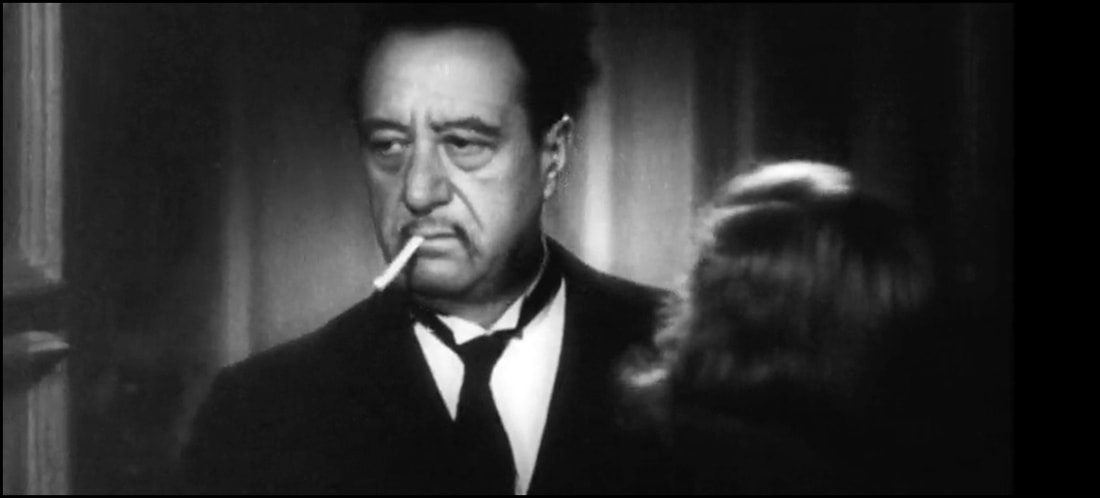
This brilliant set-up wonderfully introduces the dynamic of the entire film. As the remainder of its 95-minute run-time unfold, we’re treated to the various layers of society – along with the movers and shakers of prominent and not-so-prominent families – come together around the feature’s criminal event: the dead man lying in Loursat’s attic apparently had some ties to the city’s disaffected youth – all of which appear to have been involved in no small way with the victim’s fate – and the police go about proving their theory of what went wrong instead of following the evidence wherever it might lead. Just as Nicole and the older maid rise up and take a stand tied to the structures of the day, so too will Loursat have to pull himself from his self-imposed stupor before all is said and done and take his own stand against society at large once he sees just how complicit they are in sweeping truth under the rug in their own kangaroo court.
But … is this noir?
Well, Strangers does dabble significantly in ideas of pessimism and menace the way so many good films from this period do, but there are no real heroes and/or antiheroes at work in the script as adapted by Henri-Georges Clouzot. Loursat has a logic behind his isolation, and when examined in full he’s reached a conclusion he’s found acceptable to withdraw from life. His dour expressions and his unwillingness to defend his honor against even a housemaid are part of his chosen existence; and it isn’t until he privately realizes that – like a possible happiness was one time stolen from him – so might the future of Emile Manu, the young man who appears to have been selected amongst these French people to accept the guilt for a crime he didn’t commit but may’ve had a small role in. Loursat’s actions in the finale are heroic, but again I’m not so sure that the man emerges as a film hero.
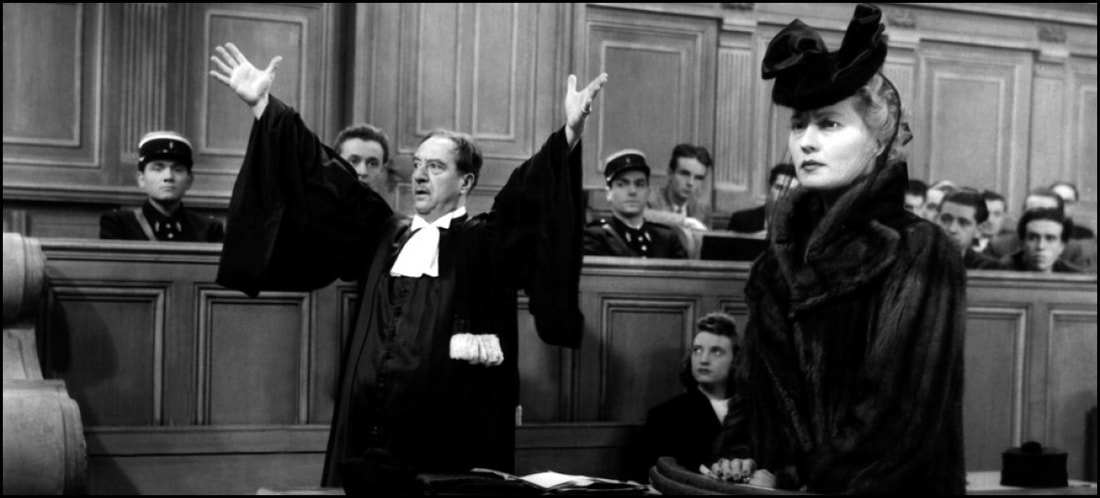
However, Loursat delivers a fascination post-mortem of this particular French society in his courtroom performance, and it’s definitely a performance for the ages.
He rather eloquently outs each and every member of the elite class – or, at least, those seated in the galley – initially demonstrating how ‘it takes a village’ to make any young soulless turk into the tarnished soul who might steal, swindle, cheat, or even murder. But because Emile is, ultimately, innocent of the crime he’s been accused of by this very society he’s willfully chosen to be one part of, the fallen man inside Loursat rises up only when such a defense is his moral duty as a citizen and as a member of that same society. He does this not as a man – because a man should be able to defend himself when the odds are fair. (Here, they aren’t.) He does this not as a father – we’ve already seen that he feels little obligation to earn Nicole’s love nor that of her suitor, Emile. Rather – as I said – he does it because he sees the evil of the mob, and this is the role he’ll play in countering their rush to judgment.
Strangers In The House (aka Les Inconnus dans la Masion) (1942) was produced by Continental Films. DVD distribution (for this particular release) is being coordinated by the good people at Kino Lorber. As for the technical specifications? While I’m no trained video expert, I found the sights and sounds of what’s reported to be a 2K restoration to be strikingly good throughout, though there was a bit of loss here and there (traditionally) in some fadeouts. As for the special features? Along with the theatrical trailer, there’s a reasonably lively audio commentary from film historians Howard S. Berger and Nathaniel Thompson. While I didn’t feel that there was a great deal of behind-the-scenes data provided, I thought the two very clearly expressed their fondness for the picture, and the discussion stayed on track most of the time. Well done.
Highly recommended.
1942’s Strangers In The House is a vivid portrait of a society in a curious kind of moral decay that we don’t often see. Evil has many faces, but courtroom dramas tend to focus more often than not on some rather obvious villainy. Here, director Decoin and his cast explore the shadows where a culture is taking those first fateful steps in a decidedly wrong direction and, yet, they’re collectively ignorant to the road that’ll put them upon. But one man awakens long enough to see the path ahead, and he does his duty by condemning them before they’ve sealed that unintentional deal with the Devil. It’s a brilliant film, punctuated with a brilliant performance for the actor Raimu.
In the interests of fairness, I’m pleased to disclose that the fine folks at Kino Lorber provided me with a complimentary Blu-ray of Strangers In The House (1942) by request for the expressed purpose of completing this review. Their contribution to me in no way, shape, or form influenced my opinion of it.
-- EZ
But … is this noir?
Well, Strangers does dabble significantly in ideas of pessimism and menace the way so many good films from this period do, but there are no real heroes and/or antiheroes at work in the script as adapted by Henri-Georges Clouzot. Loursat has a logic behind his isolation, and when examined in full he’s reached a conclusion he’s found acceptable to withdraw from life. His dour expressions and his unwillingness to defend his honor against even a housemaid are part of his chosen existence; and it isn’t until he privately realizes that – like a possible happiness was one time stolen from him – so might the future of Emile Manu, the young man who appears to have been selected amongst these French people to accept the guilt for a crime he didn’t commit but may’ve had a small role in. Loursat’s actions in the finale are heroic, but again I’m not so sure that the man emerges as a film hero.
However, Loursat delivers a fascination post-mortem of this particular French society in his courtroom performance, and it’s definitely a performance for the ages.
He rather eloquently outs each and every member of the elite class – or, at least, those seated in the galley – initially demonstrating how ‘it takes a village’ to make any young soulless turk into the tarnished soul who might steal, swindle, cheat, or even murder. But because Emile is, ultimately, innocent of the crime he’s been accused of by this very society he’s willfully chosen to be one part of, the fallen man inside Loursat rises up only when such a defense is his moral duty as a citizen and as a member of that same society. He does this not as a man – because a man should be able to defend himself when the odds are fair. (Here, they aren’t.) He does this not as a father – we’ve already seen that he feels little obligation to earn Nicole’s love nor that of her suitor, Emile. Rather – as I said – he does it because he sees the evil of the mob, and this is the role he’ll play in countering their rush to judgment.
Strangers In The House (aka Les Inconnus dans la Masion) (1942) was produced by Continental Films. DVD distribution (for this particular release) is being coordinated by the good people at Kino Lorber. As for the technical specifications? While I’m no trained video expert, I found the sights and sounds of what’s reported to be a 2K restoration to be strikingly good throughout, though there was a bit of loss here and there (traditionally) in some fadeouts. As for the special features? Along with the theatrical trailer, there’s a reasonably lively audio commentary from film historians Howard S. Berger and Nathaniel Thompson. While I didn’t feel that there was a great deal of behind-the-scenes data provided, I thought the two very clearly expressed their fondness for the picture, and the discussion stayed on track most of the time. Well done.
Highly recommended.
1942’s Strangers In The House is a vivid portrait of a society in a curious kind of moral decay that we don’t often see. Evil has many faces, but courtroom dramas tend to focus more often than not on some rather obvious villainy. Here, director Decoin and his cast explore the shadows where a culture is taking those first fateful steps in a decidedly wrong direction and, yet, they’re collectively ignorant to the road that’ll put them upon. But one man awakens long enough to see the path ahead, and he does his duty by condemning them before they’ve sealed that unintentional deal with the Devil. It’s a brilliant film, punctuated with a brilliant performance for the actor Raimu.
In the interests of fairness, I’m pleased to disclose that the fine folks at Kino Lorber provided me with a complimentary Blu-ray of Strangers In The House (1942) by request for the expressed purpose of completing this review. Their contribution to me in no way, shape, or form influenced my opinion of it.
-- EZ
 RSS Feed