
(NOTE: The following review will contain minor spoilers necessary solely for the discussion of plot and/or characters. If you’re the type of reader who prefers a review entirely spoiler-free, then I’d encourage you to skip down to the last few paragraphs for the final assessment. If, however, you’re accepting of a few modest hints at ‘things to come,’ then read on …)
From the film’s IMDB.com page citation:
“Concerned with population over-growth, the Earth government bans, under the penalty of death, all pregnancies but one couple decides to risk having a real baby rather than legally adopt a cyborg child.”
Now …
In Z.P.G.’s defense, I think it’s important to point out that the feature was both conceived and shot during a period of Science Fiction cinema wherein storytellers had a vested interest in weaving yarns they felt that society – as a whole – needed to hear. Mankind was growing by leaps and bounds, and the sheer magnitude of these new people were allegedly already taxing our planet’s resources beyond their manageable limits; and Hollywood felt it their personal responsibility to inform their ‘cultural inferiors’ that changes were a’comin’ – whether they liked it or not – and if your average Tom, Dick and Harry didn’t toe the line then the whole world was in for an endless series of catastrophes that would spell doom for each and every one of us.
Sound familiar, you global warming enthusiasts? And here you folks believed you were first to the party!
For example, 1971’s The Omega Man (Warner Bros., Boris Sagal directed) takes audiences to a time when a biological war has all but wiped-out civilization except for the vampire-like survivors living out their nights in pursuit of Robert Neville (played by Charlton Heston), one of our world’s last uncontaminated Earthlings. This cult will stop at nothing to kill Neville because they believe this will ultimately give way to a new era, one wherein they will be at the top of the food chain. 1972’s Silent Running (Universal Pictures, Douglas Trumbull directed) portrayed a dire future wherein endless wars had all but destroyed our planet’s ecosystem, and the various governments of the world opted to preserve what flora they could aboard a series of greenhouse spaceships. Bruce Dern played astronaut Freeman Lowell, a specialist who decides the plants are too good for us so he sets out to destroy the fleet rather than give his fellow man a second chance at survival. 1973’s Soylent Green (Metro-Goldwyn-Mayer, Richard Fleischer directed) was, perhaps, one of the darkest yet: Detective Thorn (Charlton Heston again) inadvertently uncovers a conspiracy involving a powerful company providing food to our overpopulated society … but what that food is might very well be solving the population crisis without our knowledge!
From the film’s IMDB.com page citation:
“Concerned with population over-growth, the Earth government bans, under the penalty of death, all pregnancies but one couple decides to risk having a real baby rather than legally adopt a cyborg child.”
Now …
In Z.P.G.’s defense, I think it’s important to point out that the feature was both conceived and shot during a period of Science Fiction cinema wherein storytellers had a vested interest in weaving yarns they felt that society – as a whole – needed to hear. Mankind was growing by leaps and bounds, and the sheer magnitude of these new people were allegedly already taxing our planet’s resources beyond their manageable limits; and Hollywood felt it their personal responsibility to inform their ‘cultural inferiors’ that changes were a’comin’ – whether they liked it or not – and if your average Tom, Dick and Harry didn’t toe the line then the whole world was in for an endless series of catastrophes that would spell doom for each and every one of us.
Sound familiar, you global warming enthusiasts? And here you folks believed you were first to the party!
For example, 1971’s The Omega Man (Warner Bros., Boris Sagal directed) takes audiences to a time when a biological war has all but wiped-out civilization except for the vampire-like survivors living out their nights in pursuit of Robert Neville (played by Charlton Heston), one of our world’s last uncontaminated Earthlings. This cult will stop at nothing to kill Neville because they believe this will ultimately give way to a new era, one wherein they will be at the top of the food chain. 1972’s Silent Running (Universal Pictures, Douglas Trumbull directed) portrayed a dire future wherein endless wars had all but destroyed our planet’s ecosystem, and the various governments of the world opted to preserve what flora they could aboard a series of greenhouse spaceships. Bruce Dern played astronaut Freeman Lowell, a specialist who decides the plants are too good for us so he sets out to destroy the fleet rather than give his fellow man a second chance at survival. 1973’s Soylent Green (Metro-Goldwyn-Mayer, Richard Fleischer directed) was, perhaps, one of the darkest yet: Detective Thorn (Charlton Heston again) inadvertently uncovers a conspiracy involving a powerful company providing food to our overpopulated society … but what that food is might very well be solving the population crisis without our knowledge!
There are others, but I think these three aptly demonstrate the trend within Science Fiction that pointed the finger squarely at every one of us: we were the cause of the world’s greatest ills, and if we didn’t get our appetites under control then extinction would be the necessary outcome.
Into this mix was introduced a 1968 best-seller – “The Population Bomb” by Paul R. Ehrlich – a popular yet wildly inaccurate prediction of just how quickly we were heading into this Apocalypse. While I won’t get into the particulars of not just how wrong but how deeply wrong Ehrlich’s forecasts were, I think what matters most is that for a time his dire rhetoric filled just the right ears to actually give license to a modest measure of his suggested behavioral modifications. Because he amply fueled a media sensation with his prognostications, director Michael Campus joined screenwriters Max Ehrlich and Frank De Felitta in bringing one interpretation of these visions to life for the silver screen.
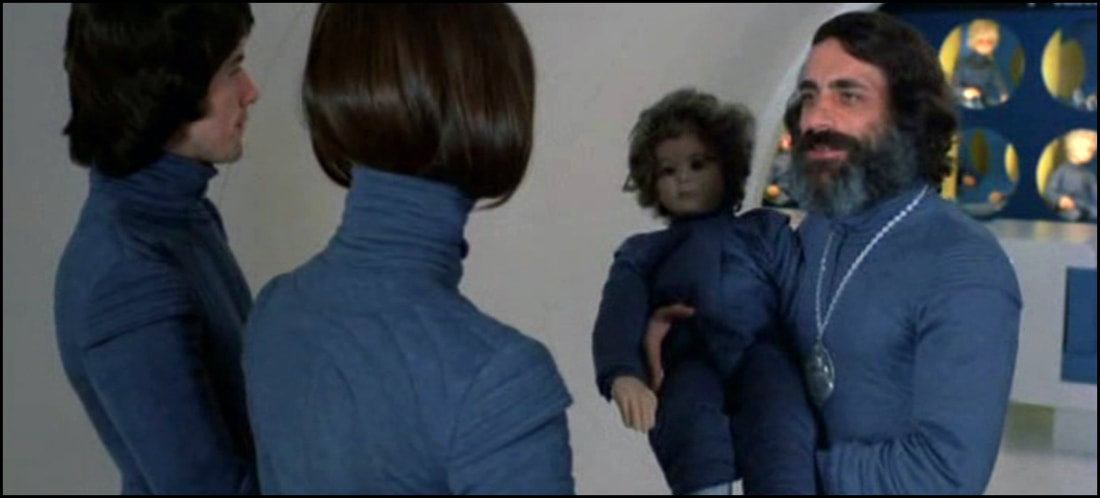
Z.P.G. – Zero Population Growth postulates a future wherein manmade ills – gluttony, greed, lust, pollution, and you name it else – have left our world a shell of its former self. Governments of the world have combined, forcing survivors into population centers wherein they can be properly managed and/or eliminated based on the willingness to abide by martial law. Those willing to abide by the strictest requirements might even benefit from special exemptions, earning either more rations or a better home in exchange for subservience. Yet – most of all – no births will be allowed … under the penalty of death for all those involved. Father. Mother. And child. No exceptions.
As you can imagine, this is a construct that makes for interesting drama as some would argue that it’s part and parcel of the human experience to create a legacy, whether this be a lasting reputation, some service to mankind, or starting a family. Science has shown us that women have an innate need to birth and nurture children, and men participate in the act of rearing the child through adolescence into maturity. Because of this biological need, the ‘WorldGov’ (as its called) has created a series of cybernetic children; couples wishing to apply might receive a robotic youngster to call their very own. (Don’t worry: it’s equipped with a ‘bonding’ interface to give it that ‘real kid’ feel.)
Into this mix was introduced a 1968 best-seller – “The Population Bomb” by Paul R. Ehrlich – a popular yet wildly inaccurate prediction of just how quickly we were heading into this Apocalypse. While I won’t get into the particulars of not just how wrong but how deeply wrong Ehrlich’s forecasts were, I think what matters most is that for a time his dire rhetoric filled just the right ears to actually give license to a modest measure of his suggested behavioral modifications. Because he amply fueled a media sensation with his prognostications, director Michael Campus joined screenwriters Max Ehrlich and Frank De Felitta in bringing one interpretation of these visions to life for the silver screen.
Z.P.G. – Zero Population Growth postulates a future wherein manmade ills – gluttony, greed, lust, pollution, and you name it else – have left our world a shell of its former self. Governments of the world have combined, forcing survivors into population centers wherein they can be properly managed and/or eliminated based on the willingness to abide by martial law. Those willing to abide by the strictest requirements might even benefit from special exemptions, earning either more rations or a better home in exchange for subservience. Yet – most of all – no births will be allowed … under the penalty of death for all those involved. Father. Mother. And child. No exceptions.
As you can imagine, this is a construct that makes for interesting drama as some would argue that it’s part and parcel of the human experience to create a legacy, whether this be a lasting reputation, some service to mankind, or starting a family. Science has shown us that women have an innate need to birth and nurture children, and men participate in the act of rearing the child through adolescence into maturity. Because of this biological need, the ‘WorldGov’ (as its called) has created a series of cybernetic children; couples wishing to apply might receive a robotic youngster to call their very own. (Don’t worry: it’s equipped with a ‘bonding’ interface to give it that ‘real kid’ feel.)
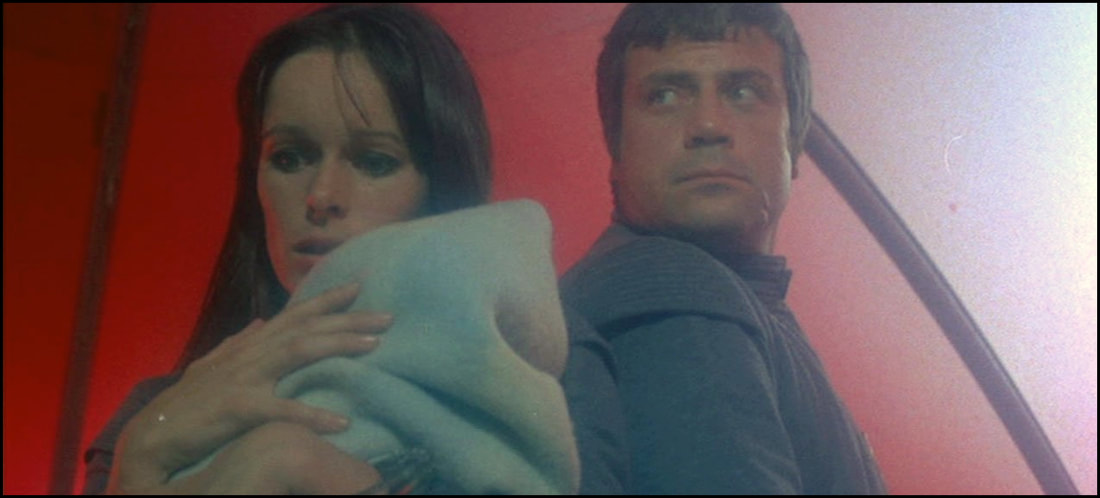
After an obligatory set-up, this is exactly where ZPG begins: Russ (Oliver Reed) and Carol (Geraldine Chaplin) stand waiting in what seems an endless line to receive their government-sponsored childbot. Once they get to the front, Carol sees the plastic robot for what it is – synthetic hair, doll eyes, and a mechanical gait and speech – and refuses to go through with it. Her desire is for a real offspring – one grown inside her as an expression of her love for her husband – and she rushes from the establishment. Russ quickly follows, and – though he’s a bit exasperated with her emotional outburst – he leads her back to their domicile.
As one might guess, Carol’s desire won’t be thwarted. One night after coupling with her husband, she silently refuses the home’s abortion machine, and their dramatic nightmare begins.
Though ZPG toys with a few related ideas, the script eventually reaches a point wherein most of the action revolves around the secret newborn and the lengths our lead couple have to go to both keep it healthy and alive. There’s a subplot involving their neighbors George and Edna (Don Gordon and Diane Cilento) who’ve also had the ‘baby itch’ and work to turn the tables of the new parents in order to abscond with the child as their own. It backfires – to a degree, but I won’t spoil it – but sets the film on course for its last reel, one that explores just how far a family’s love might push them when the government state stands in the way of its very existence.
As a story, ZPG has probably bitten off just enough that it can effectively chew. The script pretty much sticks to a single track, so the developing scenes all have their own necessity. Director Campus makes solid use of some minimalist decor as well as the occasional crowd control, showing us a world that reminds us of where we were as well as projecting one possible road to our future. A few sequences have a delicious claustrophobia to them, giving audiences the anticipation of the very walls slowly closing in on our two leads. There’s a solid milieu established consistently in the picture; a lesser steward might’ve given way to a bit of excess but most of the scenes function on their own inherent effectiveness. He definitely keeps things moving once the tale’s central conflict is introduced, but the flick does lag in a few places wherein Chaplin’s wanton gazes or Reed’s undefinable stares are given a bit too much screen exposure.
Still, I was a bit let down with its conclusion.
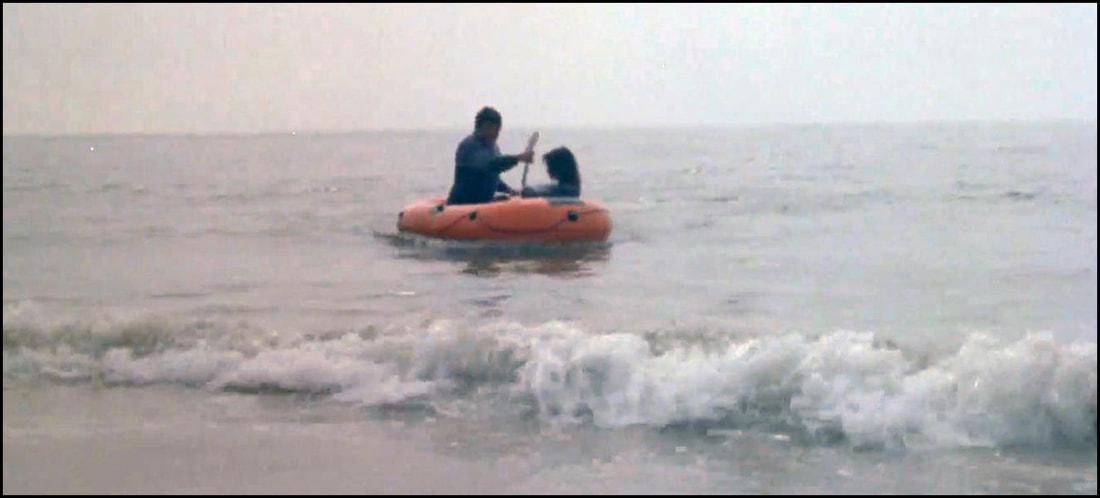
Given the circumstances of their ostracization, it’s entirely understandable why Russ and Carol (and baby makes three!) engage their final course of action. This isn’t to suggest in any way that they had a lot of options; but fleeing into the great beyond – or what’s left of one – might’ve been the only authentic possibility to the world as they’ve come to know it. Dare I suggest that it’s the easiest way out? Where Campus ultimately deposits these characters, though, begs the question as to whether or not they’ll truly survive – one could even argue that there’s the hint of a sequel at play – and I thought audiences deserved a stronger answer, one that might’ve resounded with even a cheer rather than a whimper.
As one might guess, Carol’s desire won’t be thwarted. One night after coupling with her husband, she silently refuses the home’s abortion machine, and their dramatic nightmare begins.
Though ZPG toys with a few related ideas, the script eventually reaches a point wherein most of the action revolves around the secret newborn and the lengths our lead couple have to go to both keep it healthy and alive. There’s a subplot involving their neighbors George and Edna (Don Gordon and Diane Cilento) who’ve also had the ‘baby itch’ and work to turn the tables of the new parents in order to abscond with the child as their own. It backfires – to a degree, but I won’t spoil it – but sets the film on course for its last reel, one that explores just how far a family’s love might push them when the government state stands in the way of its very existence.
As a story, ZPG has probably bitten off just enough that it can effectively chew. The script pretty much sticks to a single track, so the developing scenes all have their own necessity. Director Campus makes solid use of some minimalist decor as well as the occasional crowd control, showing us a world that reminds us of where we were as well as projecting one possible road to our future. A few sequences have a delicious claustrophobia to them, giving audiences the anticipation of the very walls slowly closing in on our two leads. There’s a solid milieu established consistently in the picture; a lesser steward might’ve given way to a bit of excess but most of the scenes function on their own inherent effectiveness. He definitely keeps things moving once the tale’s central conflict is introduced, but the flick does lag in a few places wherein Chaplin’s wanton gazes or Reed’s undefinable stares are given a bit too much screen exposure.
Still, I was a bit let down with its conclusion.
Given the circumstances of their ostracization, it’s entirely understandable why Russ and Carol (and baby makes three!) engage their final course of action. This isn’t to suggest in any way that they had a lot of options; but fleeing into the great beyond – or what’s left of one – might’ve been the only authentic possibility to the world as they’ve come to know it. Dare I suggest that it’s the easiest way out? Where Campus ultimately deposits these characters, though, begs the question as to whether or not they’ll truly survive – one could even argue that there’s the hint of a sequel at play – and I thought audiences deserved a stronger answer, one that might’ve resounded with even a cheer rather than a whimper.
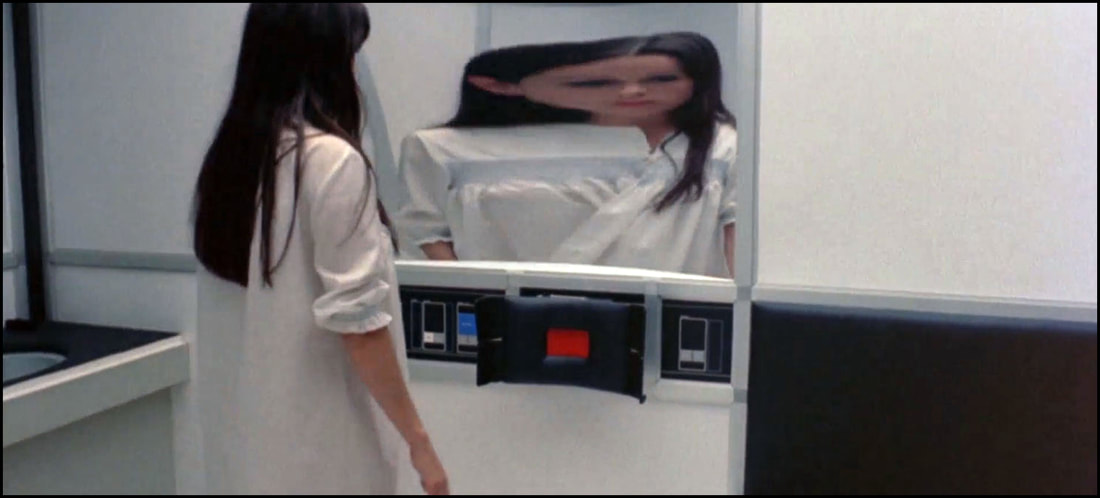
Alongside George Orwell’s 1984, I’d also argue that ZPG certainly shows the authentic fascist dangers of institutional overreach on the part of centralized government. The characters who populate this world do so only with their full subservience to an unseen yet omnipresent overlord; this is one of cinema’s better depictions of a chief administration that no longer serves the individual but vice versa. Authorities – even your family doctor – appear via massive television screens, and they speak in tones of power, severity, and finality. (Carol’s visit with her personal physician regarding her unquenchable desire to have a baby is particularly chilling, aided by a brief but effective performance by Aubrey Woods as the not-so-nice physician.) Aircraft hover over the city dispensing daily instruction to its citizens, telling them not only the how and why of their existence but also encouraging some to report on their neighbors’ unwillingness to comply with federal edicts. You’ve heard of ‘see something, say something?’ This is that on steroids, and you just might earn your next meal ticket for ratting out your brother.
Dark times, indeed.
Z.P.G. – Zero Population Growth (1972) was produced by Sagittarius Productions, Inc. DVD distribution (for this particular release) was coordinated by the good people at Kino Lorber. As for the technical specifications? This 2017 release doesn’t show that the sound and/or video were upgraded, so I’m working from the assumption that this was a standard release. As for the special features? Well, there’s an audio commentary track provided by film historian Steve Ryfle that’s definitely worth a listen. Sadly, I didn’t think the track gave much information on this particular film so much as it tried to balance the expert’s reflections on Science Fiction of its era with recounting an awful lot of facts and figures related to the wider cast and crew. It’s a good listen; I just don’t recall all that much being film specific.
Recommended.
Because so very much of Z.P.G. – Zero Population Growth’s overall aesthetic is decidedly dour, it’s the kind of experience that might be considered a one-timer. Repeat watching – unless you’re really, really, really into this kind of thing – is negligible at best. Still, I think the film rather efficiently makes use of its grim circumstances in enough small and palatable ways that it deserves to be discovered by fans of such flicks as Planet Of The Apes (1968), THX 1138 (1971), Silent Running (1972), and Logan’s Run (1976). In fact, I thought the film thematically was very similar to Logan’s Run – it might even make a great double bill for enthusiasts who want to enjoy them back-to-back – except it doesn’t end with the same upbeat tone as does Run.
In the interests of fairness, I’m pleased to disclose that this review was penned entirely as a result of my personal purchase of Z.P.G. – Zero Population Growth from Amazon.com (the 2017 Kino Lorber release).
-- EZ
Dark times, indeed.
Z.P.G. – Zero Population Growth (1972) was produced by Sagittarius Productions, Inc. DVD distribution (for this particular release) was coordinated by the good people at Kino Lorber. As for the technical specifications? This 2017 release doesn’t show that the sound and/or video were upgraded, so I’m working from the assumption that this was a standard release. As for the special features? Well, there’s an audio commentary track provided by film historian Steve Ryfle that’s definitely worth a listen. Sadly, I didn’t think the track gave much information on this particular film so much as it tried to balance the expert’s reflections on Science Fiction of its era with recounting an awful lot of facts and figures related to the wider cast and crew. It’s a good listen; I just don’t recall all that much being film specific.
Recommended.
Because so very much of Z.P.G. – Zero Population Growth’s overall aesthetic is decidedly dour, it’s the kind of experience that might be considered a one-timer. Repeat watching – unless you’re really, really, really into this kind of thing – is negligible at best. Still, I think the film rather efficiently makes use of its grim circumstances in enough small and palatable ways that it deserves to be discovered by fans of such flicks as Planet Of The Apes (1968), THX 1138 (1971), Silent Running (1972), and Logan’s Run (1976). In fact, I thought the film thematically was very similar to Logan’s Run – it might even make a great double bill for enthusiasts who want to enjoy them back-to-back – except it doesn’t end with the same upbeat tone as does Run.
In the interests of fairness, I’m pleased to disclose that this review was penned entirely as a result of my personal purchase of Z.P.G. – Zero Population Growth from Amazon.com (the 2017 Kino Lorber release).
-- EZ
 RSS Feed