SCIFIHISTORY.NET
  • MAINPAGE
  • About
  • Reviews

Stardate 06.21.2023.A: 1950's 'One Way Street' Is Vintage Film Noir That Relies On Two Surprising Performances

6/21/2023

0 Comments

 
Picture
As I’ve said before, I’m quite smitten with the world of film noir.
 
Honestly, I love it for a whole lot of reasons but only one in particular that I often share with readers here: I see film noir as a black-and-white existence most often populated with broken people making broken choices, and I like to call these characters ‘monsters of a sort.’  That’s why I’ll occasionally cover noirs in this space – along with the Science Fiction, Fantasy, and Horror features – when I get the inkling, and that happens a lot when I can squeeze in the screenings.
 
Such is the case today as I was graciously provided a complimentary Blu-ray set by Kino Lorber: Film Noir – The Dark Side Of Cinema, Volume XIV.
 
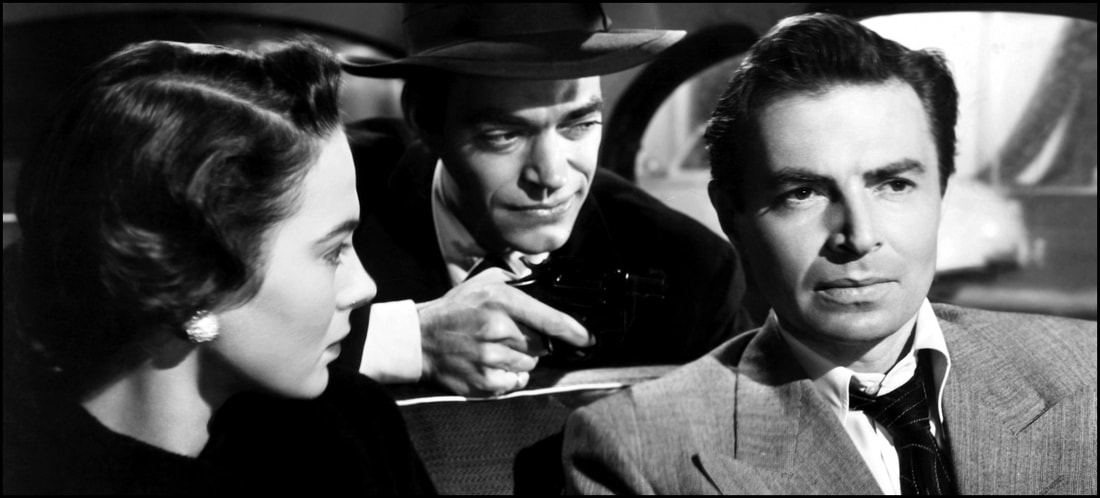
Today’s viewing: 1950’s One Way Street was another pleasant surprise for an evening viewing as it’s another noir I’d never heard anything about.  Directed by Hugo Fregonese from a story by Lawrence Kimble, it’s a lean and mean 79-minute drama that musters some impressive menace on both sides of the border (if you know what I mean, but if not you will soon).  It stars James Mason, Märta Torén, Dan Duryea, Basil Ruysdael, and William Conrad in key roles.
 
(NOTE: The following review will contain minor spoilers necessary solely for the discussion of plot and/or characters.  If you’re the type of reader who prefers a review entirely spoiler-free, then I’d encourage you to skip down to the last few paragraphs for the final assessment.  If, however, you’re accepting of a few modest hints at ‘things to come,’ then read on …)
 
From the film’s IMDB.com page citation:
“After stealing a gangster’s money and his girlfriend, a doctor heads for a small village in Mexico.”
 
I’ve got to hand it to the people at both Kino Lorber and Universal International Pictures (UI) this morning.  As of this writing, they’re an incredible fourteen sets in with their seemingly endless Film Noir: The Dark Side Of Cinema home video releases, and they’re still producing some pictures that I’ve never heard of (not that I know all), that are truly quite good even though they’re dated, and that continue to demonstrate why noir – of all sub-genres – grew to prominence and continues to influence audiences and storytellers so many decades later.
 
And about One Way Street?
 
Those who’ve read any number of my ‘Monsters Of A Sort’ columns likely know that I’ve had to kinda/sorta redefine my expectations over the years as to what constitutes a legitimate film noir.  Frankly, I think it’s a sub-genre that’s been misunderstood by many, and that sentiment applies to me as much as the next person.  Initially, I’d always known about the preferred time period, but I’d been told many moons ago (by a college professor) that one requirement was that all of a film’s characters had to (essentially) be either evil or riddled with human flaws.  Now that I’m older, thinking for myself, and continuing to grow my own knowledge of film and its legacy, I know that definition was never quite correct, but I still fall back on it from time-to-time when I think I’ve found a particular release that fits.  Fregonese’s One Way Street most decidedly does, and it does so very well.
​
Picture
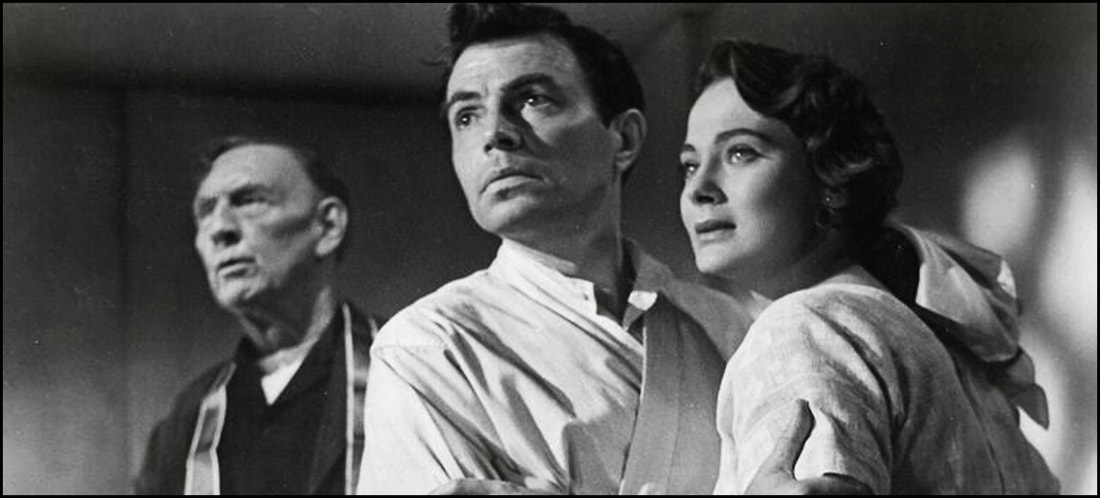
Mason plays Dr. Frank Matson, a physician who operates a side gig aiding local mobsters when they’re in need of some medical assistance.  When he realizes that stealing a single take from John Wheeler (Dan Duryea) and his gang from a deal gone wrong, the temptation is too great.  To complicate matters, Matson also takes Wheeler’s gal pal Laura (Märta Torén) as a hostage and love interest, and this means that – no matter where he goes – he’ll always be a subject of interest for the mob, putting the two of them forever at risk.
 
What I think works so well in Street is that Mason pretty consistently underplays everything.  Even when he’s clearly caught up in tension and/or jeopardy, he maintains a level of calm that one expects from a man of medicine.  Never jumping to rash conclusions because he’s already thought things through, he avoids the usual trappings of genre characters visibly vacillating between right and wrong; once he’s made his decision, he goes through with it, and this gives the film a degree of freshness rarely seen in noir (based on my experience).
 
Similarly, Street benefits from a similar temperament displayed by Father Moreno (Basil Ruysdael).  A man of the cloth, he spends his time amongst the poor rural folks of Mexico, but – as he’s learned that the country can be a dangerous place – he isn’t above telling a white lie here and there if it’ll keep himself and those around him free from marauders and bandits.  He’s a knowing yet wry performance, and – like Mason’s clear-headed physician – that isn’t something one sees in a great deal of crime dramas.
 
But, alas, not all is perfect in this Street, and that’s most likely because the format almost always requires a bad ending for most if not all of the principles.  I found what happened in the final reel to be a bit uneven precisely because I’d been somewhat distracted by these surprisingly engaging characters, causing me to take my eye off the road, so to speak.  In a world wherein both good deeds and bad deeds extract a price, I guess it’s safe to say that no one gets out alive … especially when something resembling redemption is so close within one’s reach.
 
That, my friends, is the stuff of the best noirs, and I think it applies here quite well.
 
One Way Street (1950) was produced by Universal International Pictures (UI).  DVD distribution (for this particular release) is being coordinated by the good people at Kino Lorber.  As for the technical specifications?  There’s no indication on the product package that this pressing received any new updates/upgrades, but – though I’m no trained video expert – I thought the sights and sounds here were very good.  Lastly, if you’re looking for special features?  The disc boasts the theatrical trailer as well as a commentary track provided by film historian Lee Gambin and Costume Historian Elissa Rose.
 
Highly recommended.
 
While I wasn’t all that enamored with our lead character’s eleventh-hour twist-of-fate, One Way Street is a surprisingly good dramatic thriller – with, yes, very pronounced noir sensibilities here and there – bolstered by a fabulous pair of winning portrayals from Mason and Torén.  Be warned: it does slow down a bit in the middle third – it appears that our somewhat unlikely lovebirds may just have managed to achieve the impossible of a clean getaway – but its bookends testify perhaps to why noir-flavored flicks never quite go out of style … they simply tuck their sad sack of a head between their legs, lay low, and wait for the right opportunity to come back again.
 
In the interests of fairness, I’m pleased to disclose that the fine folks at Kino Lorber provided me with a complimentary One Way Street (1950) – as part of their Film Noir: The Dark Side Of Cinema XIV collection – by request for the expressed purposes of completing this review.  Their contribution to me in no way, shape, or form influenced my opinion of it.
 
-- EZ
0 Comments

Stardate 06.20.2023.E: Black Mirror's 'Loch Henry' (S06E02) Examines Our Cultural Fixation On Unsolved Murders

6/20/2023

0 Comments

 
Picture
(NOTE: The following review will contain minor spoilers necessary solely for the discussion of plot and/or characters.  If you’re the type of reader who prefers a review entirely spoiler-free, then I’d encourage you to skip down to the last few paragraphs for the final assessment.  If, however, you’re accepting of a few modest hints at ‘things to come,’ then read on …)
 
From the episode’s IMDB.com page citation:
“A young couple travel to a sleepy Scottish town to start work on a genteel nature documentary – but find themselves drawn to a juicy local story involving shocking events of the past.”
 
Think what you will, but not all of ‘small town America’ is baseball, hot apple pie, and Jimmy Stewart.
 
To be fair, I can say this because, yes, I grew up in a small town in the middle of the great American plains.  This was at a time when, sadly, industry was disappearing from an awful lot of small places that weren’t fortunate enough to have a passing interstate; so the employment – and future prospects – for a whole generation of youth – basically, my generation – was quickly disappearing.  No matter how many new companies and/or businesses could spring up overnight, there’s just no replacing a major manufacturer shutting down … with the elimination of, say, three, four, or five hundred jobs.  When little cities close up shop, they pretty much close up shop for good … and the resulting pain is felt for years.
 
This is the kind of place pictured in Black Mirror’s Loch Henry: a once prosperous and perhaps idyllic tourist trap lost its share of the local wealth when one of its residents – Iain Adair – turned out to be a closeted serial killer.  As you can imagine, those longtime visitors opted to head to other (safer) destinations in the days ahead, so Loch Henry’s shops and restaurants and pubs were forced to shut their doors once and for all.  With no prospects for a future, even the residents began moving far and away, setting their sights on greener pastures and leaving the once hustling and bustling little jaunt behind in the rear-view mirrors.  Those who remained?  Well, they got by, mostly on the kindness of themselves and what few others who passed their way, but it’s indeed slim pickings for an existence if Loch Henry is one’s final destination.
 
So it ain’t hard to imagine just how a darkness might take hold in such a quaint hole, and that’s the substance of this particular installment to the popular Netflix streaming anthology.  When a former resident comes back home to visit his mother, he and his videographer girlfriend slowly stumble onto the idea of producing one of those ‘true crime’ podcasts examining the circumstances of the local legend.  The setting is perfect, and the town’s cultural unraveling is exactly the kind of thing audiences are attracted to, so it would seem that history is not quite finished with the loch.  Pulling back the layer of time – and uncovering a few still-lingering connections to what went down that fateful day – only produces questions that may or may not deserve to be answered.  Either way, it becomes pretty clear early on that something remains in place, and this disturbance just might prove to be the death of them.
 
The problem with both watching and reading as many mysteries – true crime and otherwise – that I have practically guarantees I’m likely to see the strings being pulled along the way; and that’s exactly why I struggled with enjoying a good deal of Loch Henry.  Too much of its details unspool in a theatrically obvious way – or, if not obvious, then far too formulaically – and I suspect that many who discover this hour are likely to find it predictable.  While its performances and production details are all spot on, there’s just no obscuring the central recipe strongly enough to maintain the level of suspense and/or disbelief required to make it as compelling – nor as fresh – as needed.
 
Sometimes a good yarn is just … well … a different ball of yarn.
 
Black Mirror’s “Loch Henry” (S06E02) was produced by Charlie Brooker and company in cooperation with Netflix.  The episode is currently available for viewing on the streaming giant.  As for the technical specifications?  While I’m no trained video expert, I thought the accompanying sights and sounds were exceptional from start-to-finish.
 
There’s absolutely nothing wrong with being entertained quietly by “Loch Henry.”  As a kinda/sorta polished riff on society’s long-established fascination with true crimes and unsolved murders, it functions quite nicely as an amiable yet mildly ominous distraction.  Rest assured: as I’ve come from a small town, I’ll guarantee each of them has their own share of secrets best left unexplored.  But as there’s just nothing different to the formula – and you’re pretty much assured of there being some twist likely coming before the inevitable conclusion (this is Black Mirror, after all) – the final estimation is reasonably easy-to-predict even if you’re watching with one eye or one hand tied behind your back.
 
In the interests of fairness, I’m pleased to disclose that the entire sixth season of Black Mirror is presently available to me as a current Netflix subscriber, and I was provided absolutely no advance screening of any episodes in exchange for a complimentary review.

​-- EZ
0 Comments

Stardate 06.20.2023.D: Monsters Of A Sort - 1950's 'Undercover Girl' Puts A Good Gal In A Tough Spot

6/20/2023

0 Comments

 
Picture
​As I’ve said before, I’m quite smitten with the world of film noir.
 
Honestly, I love it for a whole lot of reasons but only one in particular that I often share with readers here: I see film noir as a black-and-white existence most often populated with broken people making broken choices, and I like to call these characters ‘monsters of a sort.’  That’s why I’ll occasionally cover noirs in this space – along with the Science Fiction, Fantasy, and Horror features – when I get the inkling, and that happens a lot when I can squeeze in the screenings.
 
Such is the case today as I was graciously provided a complimentary Blu-ray set by Kino Lorber: Film Noir – The Dark Side Of Cinema, Volume XIV.
 
Today’s viewing: 1950’s Undercover Girl comes from the combined efforts of director Joseph Pevney (who interestingly enough marshaled a lot of Star Trek to the small screen in the late 1960’s) and writers Harry Essex, Robert Hardy Andrews, and Francis Rosenwald.  The crime drama stars Alexis Smith, Scott Brady, Richard Egan, Gladys George, and Edmon Ryan.
 
(NOTE: The following review will contain minor spoilers necessary solely for the discussion of plot and/or characters.  If you’re the type of reader who prefers a review entirely spoiler-free, then I’d encourage you to skip down to the last few paragraphs for the final assessment.  If, however, you’re accepting of a few modest hints at ‘things to come,’ then read on …)
 
From the film’s IMDB.com page citation:
“A young woman joins the Police Department in order to track down the killer who murdered her father.”
 
Sometimes, readers notice that I’ve remarked how a certain film – one that gets advertised to me as film noir – doesn’t quite fit with what I’ve known as noir for much of my life.
 
In short, this kinda/sorta exposes that film noir – as its own unique subset of the conventional thriller – has never quite operated culturally from the same starting place.  For me, I’ve seen its definition shift over the years; and while those in certain circles have always maintained some very specific criteria requiring a title for inclusion in the genre, viewing audiences have been a bit more tolerate.
 
I think it’s safe to say that most folks who’ve seen Undercover Girl – regular folks, people like you and me – would stop short of thinking of it in the same breath or context as Laura (1944), Double Indemnity (1944), or Out Of The Past (1947).  Simply put, it doesn’t quite have the narrative stuffing much less the intellectual weight of those pictures, instead offering up a fairly routine crime drama that only hints at the complexities other entries bring front-and-center.  Again, I’m not offering that observation to suggest it isn’t worth the time and effort; rather, it’s that most audiences will likely not much remember it except for a few passages that only approach what others accomplishes a bit more vividly.
 
Picture
Although I couldn’t say from where, I know that I’ve read about the work (and praise) of actress Alexis Smith; she headlines Undercover Girl as the policewoman in training who kinda/sorta falls into the assignment that links to her cop-father’s death.  A look at her IMDB.com doesn’t necessarily bring up any bright spots in my memory – her heyday was certainly the 1950’s, though TV appearances made up a good deal of her resume through the 1970’s up until her death from brain cancer in 1993 – but there are a few pictures of note I’ve seen and enjoyed.  The script for Undercover never quite gives her character the range and weight I think it could’ve had; Smith manages to squeeze in two sides to the character of ‘Christine Miller,’ even though the story as presented never quite requires a great deal of depth.  The performance is more serviceable than anything else, and I’m left wondering if she was capable of doing more with it were it required.
 
Sadly, the picture is absent a real enemy.  (Don’t get me wrong: there’s an obvious bad guy or two in here, but they’re fairly tame.)  Without a baddie with which to truly appear either in tandem with or in opposition to, Undercover occasionally feels like it could’ve twisted and turned in any direction whilst never really amounting to all that much.  A few good moments of melodrama – along with her blown identity in the final reel – finally brings a bit of boil to the pot; it’s all just a little too little a little too late for this lover of black-and-white thrillers.
 
Undercover Girl (1950) was produced by Universal International Pictures (UI).  DVD distribution (for this particular release) is being coordinated by the good folks at Kino Lorber.  As for the technical specifications?  There’s no indication of this particular pressing was afforded any new mastering, but don’t let that put you off: it all looks and sounds very good, and there’s some pretty solid cinematography here and there for those who like that kinda thing.  Lastly, the disc boasts a theatrical trailer and an audio commentary from historian/author Julie Kirgo.
 
Mildly Recommended.
 
Undercover Girl (1950) is one of those thrillers that definitely ends better than it begins.  The set-up sequence is good, and it hints toward something that feels more hard-boiled than it evolves, instead going a bit softer with villains a bit too photogenic for their time and place.  Smith proves up to the task in a good finish, but this one kinda/sorta failed to resonate the way so many other noirs have with me.  Perhaps it’s a bit too crisp and clean for my tastes, after all.
 
In the interests of fairness, I’m pleased to disclose that the fine folks at Kino Lorber provided me with a complimentary Undercover Girl (1950) – as part of their Film Noir: The Dark Side Of Cinema XIV collection – by request for the expressed purposes of completing this review.  Their contribution to me in no way, shape, or form influenced my opinion of it.

​-- EZ
0 Comments

Stardate 06.20.2023.C: 2023's 'Joan Is Awful' Episode Of Black Mirror (S06E01) Proves That We're All Joan Now

6/20/2023

0 Comments

 
Picture
(NOTE: The following review will contain minor spoilers necessary solely for the discussion of plot and/or characters.  If you’re the type of reader who prefers a review entirely spoiler-free, then I’d encourage you to skip down to the last few paragraphs for the final assessment.  If, however, you’re accepting of a few modest hints at ‘things to come,’ then read on …)
 
From the episode’s IMDB.com page citation:
“An average woman is stunned to discover a global streaming platform has launched a prestige TV drama adaptation of her life – in which she is portrayed by Hollywood A-lister Salma Hayek.”
 
Whether you’ll admit it or not, I suspect that each of us holds some secret yet dire fear about the intrusion our present level of technology affords our cultural betters.
 
Now, mind you: this doesn’t necessarily mean that each of us has a deep, dark desire to run out and smash our cell phones, our WiFi devices, or any of our Smart TVs.  All I’m trying to say in this humble prose is that we probably have some latent concern – some subconscious issue – about who could be listening in to our most private moments.  This is likely fueled as much by the natural desire to avoid any lasting embarrassment as it is an anxiety tied to just how much Google or Siri might be listening in when they shouldn’t be, but it’s still the kind of thing we’re more likely to joke about amongst friends than we are to functionally do anything to avoid.
 
It's this clinical exposure to what irks us all so privately that has been the substance of so many great anthologies, the present Black Mirror now included.  Years before it, Rod Serling mined such territory with both The Twilight Zone and Night Gallery, as did the writers and creators of The Outer Limits, Tales From The Darkside, Tales From The Crypt, Creepshow, and even Monsters.  (Yes, yes, and yes: I realize some of these programs might not have had as relatable subject matter, but my observation still stands.)  The very best installments of these (and other) shows have taunted and teased us in ways that made us laugh – comfortably or not so much so – at the predicaments their characters have found themselves in, and I suspect that “Joan Is Awful” might very well have viewers exercising extra care – in the days ahead – about what they so blindly simply click ‘accept & continue’ on their iPhone.
 
Joan (played – on one level – by Annie Murphy) – meant to be an ‘Everyman’ character but a bit too far removed in the role of a faceless executive to work fully as designed – isn’t exactly enjoying her best life but is – like so many – making the best of it.  Trapped in a somewhat loveless relationship with her significant other, she wiles away her therapy sessions wining about what could’ve / should’ve / would’ve been, never mustering the confidence to fully go out and seize the day because, quite frankly, that’d be exhausting.  But relaxing one night in front of the TV with her milquetoast paramour Krish (Avi Nash), she suddenly finds the details of her day just lived on full display globally via an entertainment platform called Streamberry (clearly a Netflix-inspired clone).  What’s she’s slow to realize is that she’s blindly signed away the highs and lows of her existence to the technological giant, and now she’s unwittingly become a media sensation as a truly contemptible human being although given the wonderful face of Salma Hayek.
 
And … what woman would refuse being played by the goddess Salma effing Hayek?!?!
 
Therein lies Joan’s dilemma: with friends, family, and total strangers increasingly privy to the shallowness inherent in her good, bad, and ugly of a thought-to-be private life, things ain’t pretty.  Her prime-time misdeeds quickly alienated everyone around her, forcing her out of a job and into a kind of cultural exile.  In no short order, she’s committed to ending Joan’s terrible, horrible, no good, very bad existence … at least in its broadcast form.  But given that she’s apparently signed away consent via the endless fine print that’s become part and parcel of any and every business commitment, this will be no easy task.
 
As Fate would have it, the plot for “Joan Is Awful” doesn’t quite end there – trust me when I say quantifying it is also no easy task – and these circumstances pile on through layers and layers, but I remain staunchly committed to not spoiling those elements I believe are best discovered by audiences on their own.  “Awful” presents more than a single compelling question for those watching closely, perhaps even challenging them to think of what they, too, may’ve unwittingly accomplished in their own private lives for convenience’s sake.  Director Ally Pankiw keeps the drama (and comedy) moving at just the right pace; Murphy has that girl-next-door quality that makes most of the hour function on its own intellectual merits; and Charlie Brooker’s script cleverly tugs at modern anxieties in ways that might make Rod Serling green with envy.
 
Black Mirror’s “Joan Is Awful” (S06E01) was produced by Charlie Brooker and company in cooperation with Netflix.  The episode is currently available for viewing on the streaming giant.  As for the technical specifications?  While I’m no trained video expert, I thought the accompanying sights and sounds were exceptional from start-to-finish.
 
Strongly recommended.
 
Black Mirror has, arguably, produced some of the best mindbenders in the modern age of television and streaming; and “Joan Is Awful” definitely deserves to be added to the growing list of smart features produced with a watchful eye tuned back on our increasing addictions to technology.  Part dark comedy (with a bit of bawd thrown in for the church scene) and part cerebral chiller, it might just make society take pause, consider what we’ve done, and promote a better course of action … but, if we did, then where would such ideas like this ever come from?
 
Nah.  We’re knuckleheads.  We’re ultimately destined for the trash heap of history.  And we’re deserving of Joan’s awful, awful destiny because she is us, we are her, she is awful, and we – alas – awful, as well.
 
In the interests of fairness, I’m pleased to disclose that the entire sixth season of Black Mirror is presently available to me as a current Netflix subscriber, and I was provided absolutely no advance screening of any episodes in exchange for a complimentary review.

​-- EZ
0 Comments

Stardate 06.20.2023.B: Monsters Of A Sort - 1957's 'Appointment With A Shadow' Turns Out To Be A Surprisingly Effective Noir Thriller

6/20/2023

2 Comments

 
Picture
As I’ve said before, I’m quite smitten with the world of film noir.
 
Honestly, I love it for a whole lot of reasons but only one in particular that I often share with readers here: I see film noir as a black-and-white existence most often populated with broken people making broken choices, and I like to call these characters ‘monsters of a sort.’  That’s why I’ll occasionally cover noirs in this space – along with the Science Fiction, Fantasy, and Horror features – when I get the inkling, and that happens a lot when I can squeeze in the screenings.
 
Such is the case today as I was graciously provided a complimentary Blu-ray set by Kino Lorber: Film Noir – The Dark Side Of Cinema, Volume XIV.
 
Today’s viewing: another late 1950’s noirish surprise that goes by the name of Appointment With A Shadow.  Directed by Richard Carlson, the screen story shows attribution to the team of Alec Coppel, Norman Jolley, and Judson Philips.  The cast includes George Nader, Joanna Moore, Brian Keith, Virginia Field, and Frank DeKova.
 
But what’s most important?  As noirs go, this one is actually quite good.
 
(NOTE: The following review will contain minor spoilers necessary solely for the discussion of plot and/or characters.  If you’re the type of reader who prefers a review entirely spoiler-free, then I’d encourage you to skip down to the last few paragraphs for the final assessment.  If, however, you’re accepting of a few modest hints at ‘things to come,’ then read on …)
 
From the film’s IMDB.com page citation:
“George Nader plays a reporter whose career is ruined by liquor.  A comeback opportunity presents itself when Nader is a bystander at the arrest of a well-known criminal.”
 
I’ve often suggested that I struggle with films that take a bit too long to develop.
 
Many within the critical industry love to call films of this type ‘the slow burn,’ but in far too many cases I feel I – as a viewer – am asked to wait too long for an interesting story to authentically swing into gear.  Acting from the 1950’s and 1960’s tends to be a touch maudlin at times – entirely too predictable – and this usually has me reaching for the fast-forward button, hoping to speed things up to the point wherein I can join the action – the true substance of an ill-paced picture – already in progress.
 
Mind you: I nearly fell into that trap with Appointment With A Shadow.
​
Picture
Much of my misjudgment was owed to the flick’s set-up: at first glance, Shadow honestly appears that it’s going to be little more than a period melodrama wherein the incessantly smitten Penny Spencer (played with syrupy conviction by Virginia Moore) is pining over what looks to be a failed love affair with alcoholic boyfriend Paul Baxter (George Nader).  At the behest of her big brother / law officer (Brian Keith), she’s given her true love one last chance: sober up, regain his place as a successful big city reporter, or get the hell out once and for all, a challenge it becomes clear poor sad sack Paul looks most likely to fail.  These scenes – while good – do play out like a bloated After School special as the actor stumbles and fumbles from one room to the next, stealing and sneaking a few loving glances at those bottles of rye the lady has kept on the premises as if to hauntingly tempt the man.  As you can guess, I had to fight that temptation to reach for the remote …
 
But, then, Baxter arrives on the scene of what’s supposed to be one of the era’s biggest police busts, only to privately learn that he may have very well just stepped into the greatest news coup of the decade!  (Spoiler rules really don’t apply, but I’m not gonna spoil this one.)  At this point, Nader’s skills as an actor truly come into play as he fights to set aside that battle with the bottle, realizing that his life has now been forced into the crosshairs in more ways than one.  What evolves from this point on is a fabulous cat-and-mouse between not only the reporter and the mob but also one man racing against the clock in that fateful place known as Noir Alley!  With no friends, no hope, and – most importantly – no alcohol to muddle his senses, Baxter relies once again on his reporter’s wits to try to stay one step ahead of the law and the lawlessness in the bid to find love, life, and longevity where none are in supply.
 
Performances are solid across the board – though I’ll admit Moore was a bit hammy, at times – and Shadow turns out to be one of the finer, quieter pictures of the noir era.  Long forgotten, this one deserves to be discovered again, and I encourage viewers to seek it out and explore.
 
Appointment With A Shadow (1957) was produced by Universal International Pictures (UI).  DVD distribution (for this particular release) is being coordinated by the fine folks at Kino Lorber.  As for the technical specifications?  While I’m no trained video expert, I thought that the sights and sounds to this advertised brand new HD master (from a 2K scan of the 35MM fine grain) to be quite good.  Lastly, if you’re looking for special features?  The disc includes an audio commentary from film historian David Del Valle and filmmaker David DeCoteau along with the theatrical trailer.
 
Strongly recommended.
 
I’ll admit that – right out of the gate – I didn’t think that Appointment With A Shadow (1957) was going to be one I’d like.  The set-up was a bit curious – maybe a bit overlong – and a few of the performances felt a bit too canned, too typical of a bygone era.  But once the film takes a twist with a fateful rooftop meeting, this nifty little ditty elevated to the point of Appointment viewing … a terrific noir tale that, surprisingly, has a few interesting character developments, a late-developing femme fatale, and a surprisingly upbeat finale.  Well crafted, director Carlson … well crafted, indeed.
 
In the interests of fairness, I’m pleased to disclose that the fine folks at Kino Lorber provided me with a complimentary Appointment With A Shadow (1957) – as part of their Film Noir: The Dark Side Of Cinema XIV collection – by request for the expressed purposes of completing this review.  Their contribution to me in no way, shape, or form influenced my opinion of it.

-- EZ
2 Comments

Stardate 06.20.2023.A: It's The End And The Beginning Of 2023's 'The Flash'

6/20/2023

0 Comments

 
Picture
Argh.  Some days, it’s hard to be a DC Comics’ fan.
 
No, no, and no: I’ll not apologize for it.  I’ve mentioned in this space – far too many times for me to ever recall – that I grew up reading DC Comic book titles.  I did read some of the Marvel stuff way back in the early 1970’s and off-and-on again in the 1980’s, but they just didn’t tickle my particular fancy the way the DC stuff did.  Some of that was owed to the writing, and some of it was more likely owed to the cast of characters; DC’s heroes just had a way of sticking to situations and circumstances that just interested me a bit more, so I was glad to hang out mostly in the pages of Superman, Batman, and a few others when covers looked inviting.  Such was the life of the great American teen growing up in the middle of nowhere, USA.
 
Still, I never much cared for The Flash.  He wasn’t a bigger-than-life player in his own book nor in the wider DC Universe, at least not so much as I saw him.  More often than not, he felt like a hero kept around for a bit of light entertainment.  Always quick with a bit of humor or a wry commentary on the state of things, he played a supporting role in a few of the team-up titles, never quite emerging so much as a force to be reckoned with but a welcome tag-a-long who made a wild ride complete with a few additional laughs.  Occasionally, writers gave him a bit more to do, though they never quite shrugged off what I saw as a bench player status, called in precisely when doing something quickly was really all that was needed.
 
Well …
 
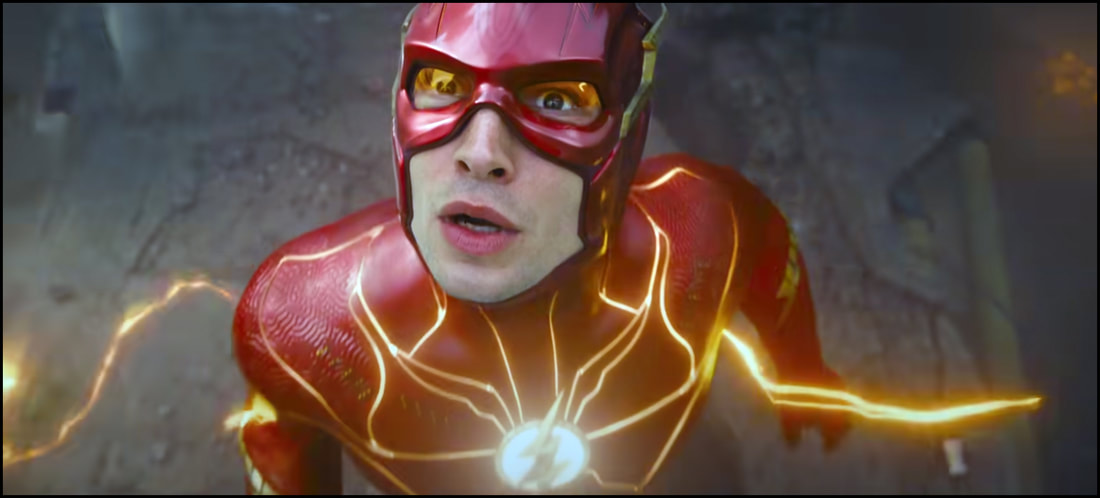
He’s finally come to the silver screen in his very own theatrical adventure.  The Flash (aka The Flash: Worlds Collide) isn’t exactly setting fire to the box office in the U.S. or abroad, though I’ll bet the suits at Warner Bros. seriously thought they had a hit on their hands.  I have my own thoughts on why the film was probably always destined to an underperformer, and I’ll be happy to explain after the break …
 
(NOTE: The following review will contain minor spoilers necessary solely for the discussion of plot and/or characters.  If you’re the type of reader who prefers a review entirely spoiler-free, then I’d encourage you to skip down to the last few paragraphs for the final assessment.  If, however, you’re accepting of a few modest hints at ‘things to come,’ then read on …)
 
From the film’s IMDB.com page citation:
“Barry Allen uses his super speed to change the past, but his attempt to save his family creates a world without super heroes, forcing him to race for his life in order to save the future.”
​

Picture
Alright, can anyone – and I do mean anyone – show me a single time travel story wherein specifically going back to alter the past ever worked out for the benefit of mankind?
 
Granted, there could be a flick here or there that somehow managed to work out entirely well for all involved, but about as long as time travel stories have been around there has been one single unifying rule to the vast majority of them: do not alter the past, or you put damn near everything into jeopardy.  From comedies to the more serious Ray Bradbury inspired narrations, audiences have been cautioned with one yarn after another trying to properly recount how even the smallest alterations have led to some of the most astounding outcomes in the (new) present and the distant future.  So while The Flash’s singular exploration of this common theme that appeared in 2011’s Flashpoint miniseries may’ve been a tale quite well told, I’d argue that there still was nothing all that revelatory about it in the grand scheme of time travel adventures.
 
However … just because something is well told doesn’t mean that audiences haven’t seen it before, and – try as hard as director Andy Muschietti and screenwriters Christina Hodson and Joby Harold might – there still just wasn’t anything new added to the string of comic book films that have kinda/sorta dabbled in territory not all that far from 2023’s The Flash.  Heck, Marvel’s Infinity War (2018) and Endgame (2019) graced the big screen only a few short years ago, and Spider-Man: No Way Home (2021) is still making the rounds on pay cable.  Did the suits at DC really think that – with so many strikingly similar ideas – The Flash was going to appear even remotely novel to audiences at this point?  Yes, yes, and yes: I get that the story might have a different fabric and some flashier colors; but at the end of the day it’s still spandex for spandex’s sake, and all too much of Worlds Collide has been done and seen before much too recently … even in The Flash’s own damn universe!
 
In case folks have missed it, the DC Speedster just concluded a nine-season run on television, and quite a bit of its last few confusing seasons, in fact, explored the smaller and wider consequences of temporal and dimensional manipulation perhaps to the death of the writers’ rooms’ better ideas.  While I won’t get into any serious discussion of the TV franchise in this space, I will say that, as an effect of investing far too much time in the very same ideas Warner Bros. is now trying out in this motion picture, the television show made less and less coherent sense in the past few seasons.  At one time, I – and I think many other viewers – would’ve told you that the Grant Gustin headlined show on The CW was one of the better superhero distractions in every universe; and yet the introduction of greater and greater time travel scenarios killed the ‘feel good’ vibe of the program, ultimately sending it into narrative oblivion.  Though showrunners ended it of their own accord, I suspect even they could see the Butterfly Effect well in motion and opted to get out while the getting was good.
 
So … besides going where audiences had already gone before, what capable shoulders could The Flash’s producers rest the story on?
​
Picture
I think it’s pretty clear that – again – the suits at Warner Bros. made a huge, huge, huge miscalculation in thinking that audiences were interested in seeing a return of Michael Keaton’s Batman to the big screen.
 
Now, this isn’t to say that folks weren’t interested in Keaton, specifically, but banking so much of the nostalgia factor on pumping up the returns to a picture that cost in excess of $200 Million was a pretty big risk … especially seeing that such wistfulness hasn’t exactly been performing well fiscally as of late.  For example, popular studios like Pixar and Walt Disney have been releasing one theatrical dud after another (how’s nostalgia looking for them?), and even the recent live action incarnation of The Little Mermaid (2023) appears to be headed for fiscal disaster.  The slate of Marvel films has been on the commercial decline; while still posting some respectable box office receipts, that franchise’s chief downside has been budgets ballooning out of control.  And has anyone with a brain been watching the lessened interest in the forthcoming Indiana Jones spectacle?  The Dial Of Destiny is Harrison Ford’s third swan song with a character once epic in pop culture, and now he’s polling more and more like a grandfather long since put out to pasture.
 
Keaton’s Batman (1989) and his follow-up – Batman Returns (1992) – were popular comic book films from their day; and those films – along with Superman: The Movie (1978) and Superman II (1980) – are definitely callbacks to a time wherein both DC and the WB knew a bit more about crafting such films explicitly for the silver screen.  I’ve mentioned before that there’s a great essay in a non-fiction book titled The Many Lives Of The Batman (published in 1991) that details an incredible amount of behind-the-scenes build-up that both companies engaged in privately and jointly to establish trends and cement hype around the Caped Crusader in preparation for the first Keaton adventure; but it would seem that today’s Hollywood thinks that merely churning out one superhero film after another is all that’s required.  Again, that wouldn’t appear to be a recipe for success for Marvel presently, and I think many would agree.
 
And about Keaton?
 
While I think that there was legitimate interest in seeing the actor return to the theatrical world of Batman, I strongly believe it was in a different role: TV’s Batman Beyond delivered audiences with a younger, hipper, even far more tech savvy incarnation of the world’s greatest detective in the guise of Terry McGinnis, a whippersnapper an aged Bruce Wayne tasked with wearing the Bat-mantle into tomorrow.  In fact, it was the elderly Wayne who spent time behind-the-scenes both training and actively counseling the young hero – in real time, via Bat-radio – on his various missions against supervillains new and old.  This is where I suspect fandom wanted to see an evolution for Keaton as he remains one of the more popular actors to inhabit the original suit.  Whether or not that opportunity ever comes about looks increasingly unlikely with – ahem – The Flash’s current failure, and I find that very sad, indeed.
 
It's this constant executive mis stepping – this ever-pervasive corporate error in judgment – that plagues The Flash’s first and likely last screen outing.
​
Picture
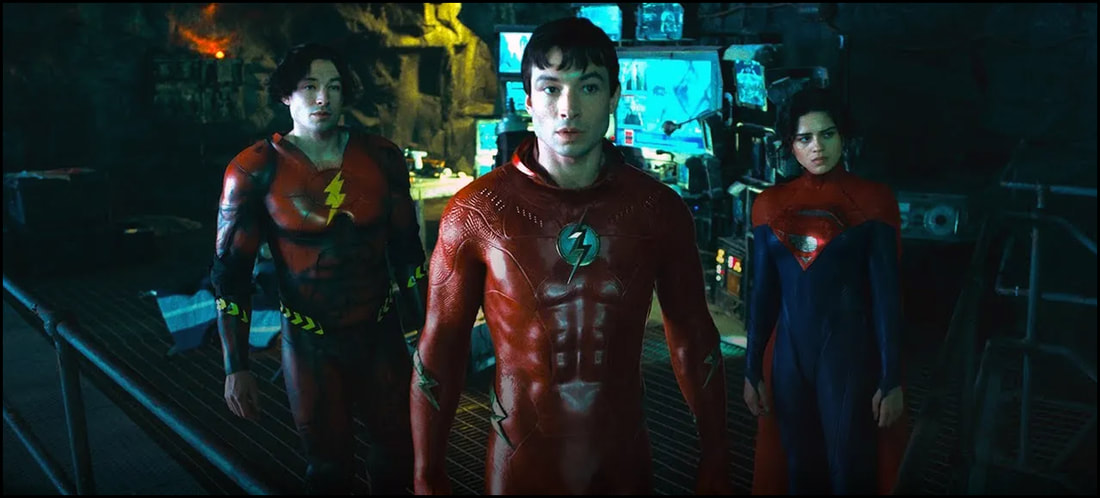
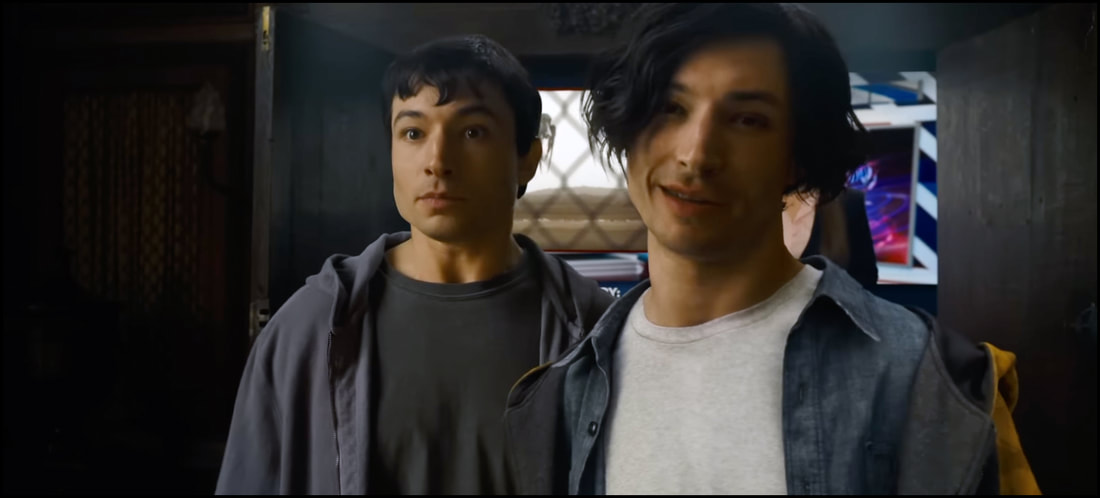
Ezra Miller – in a dual role – never quite musters the strength needed to carry the weight of the entire escapade.  Split between delivering two uniquely comic performances, there just isn’t enough substance between these related but disparate incarnations of Barry Allen to make the story resonate emotionally the way audiences require.  The film’s few good and heartfelt scenes – i.e. Bruce Wayne’s opening advice to Barry about the dangers of altering history, Barry’s final goodbye to his mother in the grocery store, etc. – get robbed of their impact most likely because producers instead wanted to spend energy and time within the Speed Force’s temporal bubble, an almost cartoony multiverse intersection that director Muschietti has even gone on record post-release to clarify was never intended to look real.  (Erm … if it doesn’t look real, then why should we accept that it and its consequences are?)  Shimmer and spectacle will never replace authentic storytelling, and I think maybe all involved in this muddled, phantasmagoric juggernaut ought be looking for a do-over as well.
 
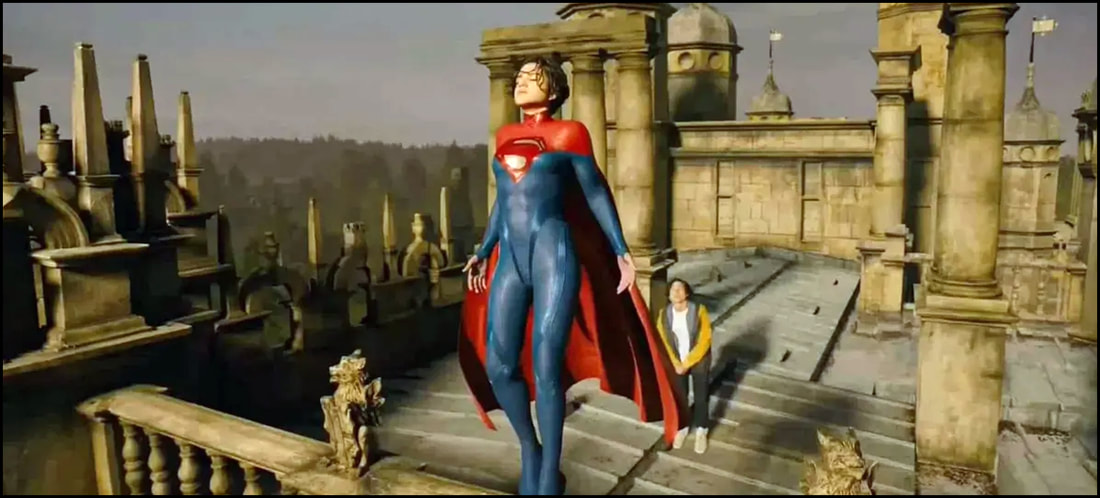
Still, this is not to say that The Flash was a complete failure.  It has some sequences – some of its various bits and pieces – that work quite well and suggest that perhaps out there in the midst of time and space there, too, is another version of the story that’s been embraced and maybe even heralded as the gamechanger Miller, Muschietti, and even DC’s resident head honcho (the controversy-laden James Gunn) claim this one to be.  Keaton’s contributions – while nice – all felt a bit forced.  The duelling Barrys managed to squeeze in some clever banter in enough places to highlight that violating the Prime Directive of time travel – never ever interact with yourself – wasn’t as uninspired a plot device as it otherwise could’ve been.  And Sasha Calle suited up quite spiffily in the role of Kara Zor-El (aka Supergirl) and practically stole the picture in what should be an introduction to an all-new iteration of that Kryptonian descendant but will likely never see the light of day.
 
The Flash (2023) was produced by DC Comics, DC Entertainment, Warner Bros., and a few more participants.  (Those wanting a full accounting can find it on the film’s IMDB.com page.)  The film is currently playing theatrically all across America.  As for the technical specifications?  While I’m no trained video expert, the flick is full of some very good – and some not so good – special effects work; sorry, folks, but I’ve long complained that comic book films more and more look like video games on the silver screen, and I’m glad that you’re all finally catching up with me.
 
Recommended.
 
About the best thing that I can say about The Flash (2023) is that – on one level – it’s a perfectly respectable popcorn movie … but that’s also about the worst thing I can say.  Thankfully, the cast and crew mostly avoided delivering the usual origins’ style storytelling, mostly relegating that stuff to the background and, instead, rushing face first into something worth talking about … like Barry’s almost unintentional destruction of time, the universe, and everything.  Alas, too much of it was the substance of dreams explored before, and what survives is likely to be the end of Miller’s time in the wider DC Universe.  Not a complete failure but one that might be talking about for ages … if there is a Zeus.

​-- EZ
0 Comments

Stardate 06.16.2023.A: With 1986's 'Dolls,' Director Stuart Gordon Perfected The 'Dirty Spielberg' Tale

6/16/2023

0 Comments

 
Picture
It’s very, very difficult to determine why any particular film becomes a cult favorite.
 
This isn’t to say that cult films don’t have characteristics in common.  In some cases, they might emerge from the same creative mind or have been marshaled to the screen by the same director.  As a result, they may have attributes that look and/or aesthetically feel similar, giving audiences an overwhelming sense of familiarity that they’re subconsciously drawn to in modest numbers.  Still – on other opportunities – the storyteller along with the cast and crew might revel in degrees of excess, turning what might be a rather ordinary experience into something extraordinary along the way.  It’s this over-the-top sensibility that more often than not turns many Horror flicks into cult favorites, giving projects the legs to stand on their own each and every time some new prospects plunk the DVD in the player or order it up for streaming.
 
And … then there’s Dolls (1986).
 
On the surface, Dolls would appear to be a Horror picture.  Its destructive cabal of animated action figures – ones coming in all shapes and sizes – seemingly exist only to lie patiently in wait for another victim to show up at their respective doors; but – for a Horror picture – there really isn’t all that much blood.  Furthermore, it never quite revels in any surplus of the usual gory circumstances or grim awareness, pretty much offing one unsuspecting victim and moving along – when appropriate – to the next.  Lastly, while it stems (in part) from the library of the late director Stuart Gordon --  a man who had a reputation at the time for producing things more than a bit drenched in blood – Dolls never quite feels much less looks like the routine Gordon potboiler.
 
So how did this … this … this thing become a cult film?
 
Well, I suspect it’s because each of us at some point in our past had a doll (though boys prefer not to call it such).  And I suspect each of us in those days gone by probably confided in that piece of fabric and plastic.  Maybe we gave it attributes, traits, or responsibilities, imagined it gave us some fateful advice, and watched over us while we slept in our beds, keeping us safe from those things that went bump in the night.  Our creativity alone imbued these precious treasures with skills and abilities beyond mortal men, and I think it’s these private but shared harmonies that resonated so well with enough viewers that Dolls became a closeted favorite.
 
(NOTE: The following review will contain minor spoilers necessary solely for the discussion of plot and/or characters.  If you’re the type of reader who prefers a review entirely spoiler-free, then I’d encourage you to skip down to the last few paragraphs for the final assessment.  If, however, you’re accepting of a few modest hints at ‘things to come,’ then read on …)
 
From the film’s IMDB.com page citation:
“A dysfunctional family of three stops by a mansion during a storm – father, stepmother, and child.  The child discovers that the elderly owners are magical toy makers and have a haunted collection of dolls.”
​

Picture
According to his professional resume, Stuart Gordon directed just over twenty films, but I think it’s safe to argue that he never made anything quite like Dolls again.  Google.com reports that 1987’s figures suggest it was shot on a budget of $2 million but went on to gross $3.5 million globally.  Though I can’t find any listing of receipts for its home video take, I suspect the flick did quite well, emerging as it did at a time when video outlets were up and running on practically every other street corner across rural America.  Charles Band’s Empire Pictures’ catalogue fared quite well in that era; so, believing that Dolls created a bit of sensation and popularity isn’t all that hard to accept.
 
As a project, Dolls isn’t all that complex: an imaginative young girl, Judy (played winningly by a young Carrie Lorraine), and her embittered father David (Ian Patrick Williams) and even worse shrew/stepmother Rosemary (Carolyn Purdy-Gordon) happen across an elderly estate that conceals more than a bit of magic and mystery where its hundreds of custom-built dolls come to life to extract a bit of plastic justice on those who’ve led some very bad, bad lives.  When the home’s elderly caretakers (exceptional performances from Guy Rolfe and Hilary Mason) invite them in for the night out of the rain – along with a few other strays who stumble on the same path – it becomes increasingly clear that not everyone is destined to make it out alive.  What can I say?  Rural Europe is a dangerous place, but we already learned that lesson from An American Werewolf In London (1981).
 
The script is attributed to Ed Naha, a name that certainly carries its own influence among those of us who follow genre materials.  His career has been filled with hits big and small including such titles as C.H.U.D. II – Bud The Chud (1989), Honey I Shrunk The Kids (1989), Dollman (1991), and Omega Doom (1996).  With Dolls, he weaves an interesting concoction, giving this particular cabal of toys enough menace to match their magic.  While his characters might suffer a bit from being a bit too predictable here and there, I think it’s safe to conclude that not even he took much of this with any degree of seriousness, crafting it all under the rubric of being a fairy tale … if not one of the darkest and deadliest fairy tales of them all.
​
Picture
Ultimately, it isn’t all that difficult to “see the seams” (as they say) that keeps the film tied together and churning effectively forward.  Although Judy’s childlike eyes always search for the innocence in things, we learn in the film’s opening that not even she is above some dark thoughts when she imagines dear old dad and his new wife being ripped to shreds by an oversized teddy bear.  (Of course, she’s suitably reprimanded for such thoughts.)  Prone to an overactive imagination (and probably due for a few therapy lessons herself), Judy still maintains throughout the picture what Hollywood types might call a Spielbergian charm – big eyes, flushed cheeks, deliciously photogenic, and more than a healthy dose of winning precociousness.  Where she and her soon bleeding costars inevitably take Dolls – with its various stabbings, scratchings, draggings, gougings, piercings, dismemberings, smashings, and the like – is probably more aptly described as ‘Dirty Spielberg.’
 
Dolls (1986) was produced by Empire Pictures and Taryn Productions, Inc.  DVD distribution (for this particular release) is being coordinated by the fine folks at Arrow Films.  As for the technical specifications?  While I’m no trained video expert, I thought that the sights and sounds to what’s reported as an all-new 2K restoration from the original interpositive to be exceptionally good.  Lastly, if you’re looking for special features?  The disc boasts an incredible three different audio commentaries (one specially recorded for this release) along with a new interview (with editor Lee Percy), a fabulous making-of documentary, and the usual fodder like photo galleries, storyboards, and theatrical trailers.  Arrow Films rarely (if ever) disappoints, and there’s plenty here to keep fans interested for quite some time.
 
Highly recommended.
 
Though the film vacillates between Horror and Fantasy, I think the narrative formula propelling Dolls from start-to-finish is quite good.  It might have a storytelling blemish here and there that could’ve been handled with greater aplomb (the opening Teddy bit is a clumsy insertion, and a particular kill sequence could’ve been handled with better reveal), but because all of it feels like its descended from a child’s cautionary fairy tale I found it hard to pick apart even the smallest scab.  There’s enough magic in here – both dark and light – to give one ample opportunity to credibly suspend disbelief and be swept off into a place where the impossible happens time and time again … even as the closing scenes prepare you for what could’ve easily been a theatrical follow-up that likely still lives on in our imagination.
 
After all, dolls never die.
 
In the interests of fairness, I’m pleased to disclose that the fine folks at Arrow Films provided me with a complimentary screening copy of Dolls (1986) as part of their Enter The Video Store: Empire Of Screams Collection for the expressed purposes of completing this review.  Their contribution to me in no way, shape, or form influenced my opinion of it.

​-- EZ
0 Comments

Stardate 06.15.2023.A: 1995's 'Waterworld' Remains A Misunderstood Genre Gem

6/15/2023

0 Comments

 
Picture
For those of you who’ve never heard (or read) me admitting this, then here it is: I already know that I do tend to be very, very, very hard on films.
 
Yes, yes, and yes.  I’m very aware that this criticism has been levied against yours truly.  Honestly, none of you who’ve let it slip in this space or in emails to SciFiHistory.Net were even among the very first to chastise me in such a way.  Over the years, many friends and a few family members have remarked on and off about my tastes, preferences, and cinematic nihilism.  The only defense I’ve ever mustered against such an onslaught is to say, simply, that – like all of you – I know what I like, and I like what I know.  When I see it, I champion it, and I’m unashamed to admit to liking a whole library of releases chiefly because they achieve something on a level that I can appreciate.  That’s all I look for in any picture, and I’ve long ago realized that it’s best for me to let that sleeping dog lie.
 
Hate me if you must, but I’ll always remain true to my word.
 
If there is any subset of pictures that I have gone a bit easy on in my decades of writing about films, then it would easily and most arguably be genre entries – SciFi, Horror, and Fantasy – that all lean a bit heavily with an emphasis on Fantasy.  Pure Horror?  Well, what can I say?  It rarely scares me.  Hard Science Fiction – as much as it pains you to read this – kinda/sorta leaves me a bit cold more often than not, often void of what I see as an authentic human voice with which to spin the tale.  Call it schmaltz – call it camp – call it cheese – but, whatever you call it, I’m usually willing to give it a free pass critically so long as it doesn’t corrupt the intrinsic nature of the longer story.  It has to work for this world as constructed, and I’m OK with that.
 
All of this brings me to the flick that kinda/sorta served as one giant blemish on the career of Hollywood juggernaut Kevin Costner: 1995’s Waterworld was deluged with some of the wickedest criticism imaginable upon its original theatrical release.  (I can assure you that it was, kids, as I was there, reading each and every bit of it along the way.)  Some of it?  Well, OK, some of it was legitimate.  Some of it was little more than piling on, as folks in the trade publications even back then tended to like chirping when they saw what they perceived as a total catastrophe.  Still, I’d argue that – as about as pure a genre film through and through that’s ever been made – Waterworld never deserved the measure of disdain it was given at the time, and I’m using this post today to try to set things right with the humblest explanation I can offer.
 
(NOTE: The following review will contain minor spoilers necessary solely for the discussion of plot and/or characters.  If you’re the type of reader who prefers a review entirely spoiler-free, then I’d encourage you to skip down to the last few paragraphs for the final assessment.  If, however, you’re accepting of a few modest hints at ‘things to come,’ then read on …)
​
Picture
From the film’s IMDB.com page citation:
“In a future where the polar ice-caps have melted and Earth is almost entirely submerged, a mutated mariner fights starvation and outlaw ‘smokers,’ and reluctantly helps a women and a young girl try to find dry land.”
 
Flights of fancy were rarely – if ever – meant to change the world.  While they might have been conceived by authors or filmmakers intending to deliver some message of hope or progress, the common denominator to all of those projects is that – first and foremost – they meant to entertain.  Educating an audience is admirable, but Fantasy as a narrative construct heavily implies that none of this is real anyway, and that’s why I think serious storytellers tend to avoid using it as a tool for social change.
 
So … anyone arguing that Waterworld is – first and foremost – a film preaching about an impending climate disaster is sadly mistaken.
 
In fact, all the Kevin Reynolds-directed film does is use the mechanics of the polar icecaps melting as a device with which to create this particular universe.  It is a world of endless water.  Our planet has apparently become one big ocean from sea to shining sea.  Nothing else in the script – from the players, the circumstances, or the predicament – comments on our world-at-large in any substantive way.  Even an environmental disaster linked to the 1989 Exxon Valdez oil tanker is largely the stuff of comic effect here, and I challenge anyone who thinks its inclusion here was meant to inspire global action to put-up-or-shut-up.  Yes, there may be the sporadic quips in the screenplay that might produce either a bit of thought on our part leading to a modest reflection on the current state of affairs, but at this point in the fictional universe absolutely nothing can be done to reverse mankind’s fate, nor is there any promise that this dire fate awaits each of us if we ignore the prognostications.
 
In the same way that the Mad Max series of motion pictures what was left of our world well after the Apocalypse was waged (and lost), Waterworld simply sets these people and their events in a context and concludes, “OK, you folks who are left can have at it!”
​
Picture
Like Mel Gibson’s Max puts the pedal to the metal in that franchise, Kevin Costner’s ‘Mariner’ does the same.  He’s his own man … well, fish … erm … fishman?  Manfish?  (Aw, hell, you decide!)  Part-man, part-fish, but with enough toxic masculinity to fuel Armageddon, Mariner opens his film with an elaborate scene of a manfish/fishman on the high seas, with an incredible wide shot all closing in on Costner urinating and, then, drinking his own piss.  (Yes, you read that right.)  With that subtext, I think it’s safe to assume that we’re truly set for a wild ride, and – on that front – I’ve always thought that Waterworld delivered.  And, no, it wasn’t all wet.
 
The script is credited to Peter Rader (who maintains an incredibly slim IMDB.com resume given the pedigree one would expect for a Costner vehicle) and David Twohy.  Twohy – for those who’ve never heard the name – has long been affiliated with Science Fiction and Fantasy, having penned scripts for such properties as Warlock (1989), The Arrival (1996), and all the stuff that is the cinematic Riddick universe.  My suspicion here is that, perhaps, Rader’s first draft was likely reworked by Twohy – though I could be wrong – as I think his background certainly suggests the experience necessary to give Waterworld its foundation.  Whatever the case may be and regardless of whose contributions belong to whom, the flick was clearly meant to be a visual spectacle of good versus evil on the high seas of tomorrow and not some Hollywood message picture rolled out during awards season.
 
But … at this point in his professional career, Costner and his star potential had lost a good deal of its luster.
 
Indeed, Waterworld is a pretty far cry from the director’s 1990 pinnacle: Dances With Wolves clearly elevated his status about as high as it could go in all of Tinseltown, and – only half a decade later – it was still the stuff of legend upon which the actor and those who followed him were likely banking their success upon.  After Wolves, Costner headlined the summer blockbuster Robin Hood: Prince Of Thieves (1991), and even that was released the same year as the critically-lauded JFK that came out under the stewardship of director Oliver Stone.  In 1992, the actor joined hands with no less than superstar Whitney Houston aboard The Bodyguard, an action/romance that continues to find fans decades after its initial release.  To be fair, there were a few other features in there, but – in my humble opinion – none of these releases prepared the world of Hollywood to embrace Costner as an emerging star in the world of … Science Fiction?
 
If you’re reading this, then perhaps we can agree on one thing?  You – like me – are a fan of SciFi.  You’re tantalized by the good and the bad of it.  Hollywood and all of its members most decidedly are not fans of SciFi.  It’s an inferior species of film.  It’s a cheap light show meant to entertain lesser people.  This doesn’t mean that it can’t be well made because even the industry craftsmen and women deserve to have work and a chance for acclaim; but these projects are still considered beneath the scope of serious actors and actresses.  No one – and I do mean no one in Hollywood – is clamoring for the chance to be rendered blue in James Cameron’s next Avatar travelogue, and this is because it’s just something they wouldn’t be caught dead in.
​
Picture
Now … imagine seeing one of their own – i.e. Kevin Costner – so willingly jumping the shark (literally) into a genre long considered by them a professional taboo?
 
This couldn’t succeed.  This film – this Waterworld – couldn’t become the norm.  Otherwise, each and every one of them might run the risk of having to sacrifice their pride and careers in some like-minded picture.  Keep in mind that industry veterans are always on the lookout for the next big craze – Star Wars launched a trend in the late 1970’s – and what if Costner’s vanity project did the same?  Was Sandworld just waiting to be greenlit?  What about Fireworld?  What about Treeworld, Grassworld, and Gasworld?  All of these would require big name talent – those who had achieved the cultural acclaim that Costner had – so, as one might imagine, this couldn’t happen.  Not at any cost.
 
So … Hollywood circled the wagons.
 
Rather than defend one of its own – rather than see the merits in a formulaic adventure yarn headlined by an A-List talent – they saw blood in the water.  (Yes, pun intended.)  It wasn’t enough to merely destroy Waterworld’s chance at launching a new franchise; they needed this picture to fade away into the dustbin of film history as a colossal commercial failure.  If it had any fans, then they were to be laughed at and ostracized, much like those who claim to see UFOs or experience abductions or hear the voice of God.  Any who supported Waterworld would be the subject of ridicule, and – thus – the film opened to a dismal box office with almost zero prospects that it would gain its sea legs over time.
 
Of course, I can’t prove any of this; and I offer it up to you – humble readers – entirely of my own opinion.  I would encourage those of you who like history to go back and read some of the trade reports into the film – to go back and even watch video reviews of that era on YouTube.com and elsewhere.  If you’re watching closely, then you might see – in small ways, perhaps none too obvious – an entire group of people secretly hoping to tank the picture, to tell you that it isn’t worth your time and attention.  While I’m not here to defend Waterworld’s every scene – having watched it several times, I assure you that there are sequences that should’ve been trimmed as well as plenty of unanswered questions about just how this place really works logically – but it’s a far, far cry from worst thing ever committed to film.
 
Waterworld (1995) was produced by Universal Pictures, Gordon Company, Davis Entertainment, and Licht/Mueller Film Corporation.  DVD distribution (for this particular release) is being coordinated by the fine folks at Arrow Films.  As for the technical specifications?  Though I’m no trained video expert, I thought the sights and sounds to this Ultra HD 4K rendering were exceptionally inviting.  As for the special features?  Well – to be blunt – there’s nothing new here as all have been essentially ported over from earlier releases of the film; so fans interested in those specifics are encouraged to scour the net as those insights are already out there.
 
Highly recommended.
 
Sorry, folks, but I’ve never had an issue with admitting that I’m a fan of Waterworld.  I’ll admit that it ain’t Shakespeare.  I’ll even concede that it’s far from Kevin Costner’s best work.  Hell, I’ll even grant you that – because it’s entirely formulaic, about as much as a genre project can be – it isn’t going to be for everyone.  But for those of us who appreciate this kind of world-building along with the commitment to seeing something through despite a veritable ocean of reported obstacles (snicker snicker), it works just fine.  Warts and all.
 
In the interests of fairness, I’m pleased to disclose that the fine folks at Arrow Films provided me with a complimentary screening copy of Waterworld (1995) Ultra HD 4K Blu-ray by request for the expressed purposes of completing this review.  Their contribution to me in no way, shape, or form influenced my opinion of it.

​-- EZ
0 Comments

Stardate 06.13.2023.B: What's In A Name? Well,  A Guarantee Of Blood ... If The Name Is 2012's Argento's Dracula

6/13/2023

0 Comments

 
Picture
How revelatory must a film truly be to include the director’s name above the picture’s title?
 
I suppose the answer will always be, “That depends on the director.”  You catch my meaning?  Different directors do tend to conjure up different impressions.  For example, I can’t imagine that there are crowds of anxious movie-goers lined up anticipating Woody Allen’s Dracula except, maybe, the Hollywood elitists.  Granted, the kids might hungrily pour out in droves and droves for Michael Bay’s Dracula.  Maybe you could interest most of middle-class America to pony up their ten bucks a-seat for Steven Spielberg’s Dracula.  Such is life in the big city.
 
For those who know the name Dario Argento, I’d imagine Argento’s Dracula might have particular significance.  Indeed, Argento has a fan-base of impressive proportions amongst cinema aficionados and horror buffs, but, outside of those two groups, is he a household name?  I’d hardly think so.  That was probably a question that producers were asking in late 2013 when this film was released merely as Dracula 3D; it largely went unattended in the marketplace, which caused them to eventually drop the whole three-D thing and just emphasize the ‘Argento’ in the new DVD release.
 
What a pain in the neck …
 
(NOTE: The following review will contain minor spoilers necessary solely for the discussion of plot and/or characters.  If you’re the type of reader who prefers a review entirely spoiler-free, then I’d encourage you to skip down to the last three paragraphs for my final assessment.  If, however, you’re accepting of a few modest hints at ‘things to come,’ then read on …)
 
From the film’s IMDB.com page citation:
“Asia Argento stars in horror legend Dario Argento’s sexy spin on the classic tale about the sharp-toothed count who craves human blood.”
 
Jonathan Harker (played by Unax Ugalde) is summoned to the castle of the Count Dracula (an impressive Thomas Kretschmann) where he’s to begin work as the resident librarian, cataloguing all of his employer’s expansive book collection.  However, once Harker seems to have vanished, his lovely wife Mina (a pleasingly attractive Marta Gastini) follows in his footsteps, seeking to uncover the truth of her love’s disappearance.  Before all is said and done, she’ll require the services of Abraham Van Helsing (the ever-reliable Rutger Hauer) to bring about an end to a vile agreement between Dracula and the townspeople he’s duped into collective subservience.
 
As of yet, I haven’t read Bram Stoker’s classic novel (it’s on my bucket list), so I couldn’t say how faithful Argento’s Dracula remains to ‘Stoker’s Dracula.’  I can say that the story certainly feels as if some minor effort went into capturing this tale as an effective but low-budget period production, not that there’s anything wrong with so much obviousness.  Everything “looks” old age, but, by that same barometer, everyone “looks” like they’re acting, too.  To my admittedly untrained eyes, Argento’s work is staged and photographed far too passively to evoke the legitimately lurid sensibilities only effectively hinted at in a few key scenes; and, sadly, there’s just an awful lot of theatrical bloat to this affair.
​
Picture
At nearly two hours, this version of the immortal bloodsucker is arguably thirty minutes too long.
 
There’s far too much set-up required in the tale as told, scripted by Argento and Antonio Tentori, Stefano Piani, and Enrique Cerezo (also listed as ‘producer’).  Lucy (Asia Argento) goes about her life in the village, secretly consorting with the leader of the vampires, and her story could’ve easily been heavily truncated to balance out the flow of the first half.  Also, there are a handful of scenes involving the locals that – while their inclusion might help establish a plot point here and there – don’t sufficiently add much depth to the overall narrative.  In fact, by the time Van Helsing shows up to finally go ‘Grandpa Badass’ on everyone, I’d pretty much lost interest in everyone except Dracula … and it’s likely he isn’t long for this world anyway.
 
Despite all of these blemishes, Kretschmann (as the Count) turns in a nice main performance.  His Dracula is charismatic in measured doses, fleshing out the ruler of the undead by giving him some emotional complexity.  This, too, unfortunately doesn’t serve the entirety of the production as strongly as it should because everyone else seems to be mimicking his delivery; far too many lines of dialogue are whispered as if they have immeasurable, incalculable significance to everything, and the end result of which the melodrama gets muddled in favor of the dramatic posturing of the players.
 
Not good, Argento.  Not good.
 
Argento’s Dracula (2013) (aka Dracula 3D) is produced by Enrique Cerezo Producciones Cinematograficas S.A., Film Export Group, and Les Films de l’Astre.  DVD distribution is being handled by MPI Media Group as part of the IFC Midnight series.  As for the technical specifications, the production has plenty of quality sights and sounds, but it’s all balanced out with some inexorably long takes; at 1:52:00, it feels at times closely to 5 hours … and that’s never a good thing.  If it’s special features you want, then there’s an impressive behind-the-scenes documentary (1 hr.), a music video, and a few theatrical trailers: a nice package, indeed, but enough about the ladies … (snicker snicker)
 
Alas … only Modestly Recommended.
 
Meh.  Argento purists (or is that ‘cultists’?) will probably be the only audience truly excited by this release.  The rest of us?  We’ll probably be left wondering what all the excitement is about.  I can appreciate even a good vampire story, and Argento’s obvious affection for the source material shines through; but so much of this Dracula is down for the count.  (Get it?)  Argento’s signature non-blood-looking blood is everywhere – at one point looking like melted crayons while still at another like cheap wine – and the absolutely unnecessary (but appreciated!) emergence of ample bosoms can only sustain a man’s interest for so long.  Worth a view, but probably only one.
 
In the interests of fairness, I’m pleased to disclose that the fine folks at MPI Media Group and IFC Midnight provided me with an advance DVD copy of Argento’s Dracula by request for the expressed purposes of completing this review.  Their contribution to me in no way, shape, or form influenced my opinion of it.

​-- EZ
0 Comments

Stardate 06.13.2023.A: In Memoriam - Treat Williams

6/13/2023

0 Comments

 
Picture
As I often remind readers, many of the actors and actresses I feature in my Daily Citation pages aren't exactly well known as genre talent; but they've made an appearance here and there that I believe warrants their inclusion to SciFiHistory.Net.  Not every smiler has the good fortune to be cast as a Captain Kirk much less a Barbarella, so I've learned to be thankful for big and small things along the way in this journey we call life.

In fact, one might have to do a bit of a deep dive into the past of Treat Williams to find a few footprints he made along the way, and -- sadly -- that's what I'm here for this morning.

Though it might be the stuff of legends in some corners of the Web-O-Sphere, Williams' contribution to the wider Star Wars mythology was not all that significant.  He appeared as an uncredited Rebel soldier aboard Star Wars: The Empire Strikes Back (1980) and has rather famously (in some circles) shared pictures of this very brief stint for all to see.

In 1987, he paid a visit to TV's Fairie Tale Theatre for good measure.

In 1988, he shared the screen with comedian Joe Piscopo in Dead Heat, a Horror/Comedy from the good people at New World Pictures.

In 1992, he stopped in for a thrill and a chill to an installment of HBO's Tales From The Crypt.

Then -- in 1996 -- he stepped deep into the wells of theatrical Fantasy with a big role: in the guise of Xander Drax, he was the face of evil squaring off against none other than The Phantom.  Though I found the feature a bit undercooked, I did like the obvious good vs. evil chemistry Williams shared with the heroic lead Billy Zane.

1998 saw the man taking to the high seas in pursuit of adventure with more than a smidgen of Horror: Deep Rising cast Williams as John Finnegan, an oceanic highjacker who does battle against some deep sea creatures.

​In 1999, the man headlined a television miniseries adaptation of Jules Verne's Adventure/Classic Journey To The Center Of The Earth for Hallmark Entertainment.  While perhaps the effort isn't as memorable as all had hoped, it did score a 2000 Saturn Award nomination in the category of 'Best Single Genre Television Presentation.'

​In 2001?  "Snakes ... why did it have to be snakes?"  Williams found himself under attack from some dangerous snakes released upon mankind by some unforeseen seismic activity in Venomous from genre director Fred Olen Ray.

Though there might be a few more, what's left does lean heavily toward more conventional fare, and I think I'll leave it at that.  If nothing else, what I've listed certainly demonstrates that the man never shied away from the worlds of Science Fiction, Fantasy, and Horror; and I think his resume -- well over one hundred different screen roles -- shows that fans hoping to relive what goodness he leaves behind will not find slim pickings when they begin their search.

As it's been said, none of us lasts forever, and word reached us yesterday that the man was involved in a motorcycle accident that cut his days short in a tragic end.

Our deepest sympathies are extended to the family, friends, and fans of Treat Williams.  May he rest in peace.

​-- EZ
0 Comments
<<Previous
Forward>>

    Reviews
    ​Archive
    ​

    Reviews

    Daily
    ​Trivia
    Archives
    ​

    January
    February
    March
    April
    May
    June
    July
    August
    September
    October
    November
    December

    original content
    ​

    October 2026
    September 2026
    August 2026
    July 2026
    June 2026
    May 2026
    April 2026
    March 2026
    February 2026
    January 2026
    December 2025
    November 2025
    October 2025
    September 2025
    August 2025
    July 2025
    June 2025
    May 2025
    April 2025
    March 2025
    February 2025
    January 2025
    December 2024
    November 2024
    October 2024
    September 2024
    August 2024
    July 2024
    June 2024
    May 2024
    April 2024
    March 2024
    February 2024
    January 2024
    December 2023
    November 2023
    October 2023
    September 2023
    August 2023
    July 2023
    June 2023
    May 2023
    April 2023
    March 2023
    February 2023
    January 2023
    December 2022
    November 2022
    October 2022
    September 2022
    August 2022
    July 2022
    June 2022
    May 2022
    April 2022
    March 2022
    February 2022
    January 2022
    December 2021
    November 2021
    October 2021
    September 2021
    August 2021
    July 2021
    June 2021
    May 2021
    April 2021
    March 2021
    February 2021
    January 2021
    December 2020
    November 2020
    October 2020
    September 2020
    August 2020
    July 2020
    June 2020
    May 2020
    April 2020
    February 2020
    January 2020
    December 2019
    November 2019
    October 2019
    September 2019
    August 2019
    July 2019
    May 2019
    March 2019
    February 2019
    January 2019
    December 2018
    November 2018
    October 2018
    September 2018
    August 2018
    June 2018
    May 2018
    March 2018
    January 2018
    December 2017
    November 2017
    October 2017
    September 2017
    August 2017
    July 2017
    June 2017
    May 2017
    April 2017
    March 2017
    February 2017
    January 2017
    December 2016
    November 2016
    October 2016
    September 2016
    August 2016
    July 2016
    June 2016
    May 2016
    October 2015
    September 2015
    August 2015
    July 2015
    June 2015
    May 2015
    March 2015
    February 2015
    January 2015
    December 2014
    November 2014
    October 2014
    September 2014
    August 2014
    July 2014
    June 2014

    RSS Feed

Proudly powered by Weebly